
This is a product manual that introduces the product features of CMB24 cable assembly, including size, materials, specifications, etc.
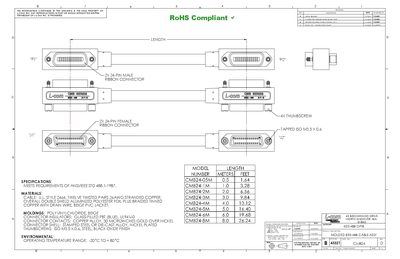
The L‑COM CMB24FSCM is a 2‑X 24‑pin male ribbon IEEE‑488 GPIB cable designed to meet ANSI/IEEE STD 488.1‑1987 requirements. The cable is RoHS compliant and intended for use in instrumentation and test equipment.
The cable construction features 26 AWG stranded copper conductors, double shielding with aluminumized polyester foil and braided tinned copper, and a beige PVC jacket. Connectors are 24‑pin male ribbon with glass‑filled PBT insulators, copper‑alloy contacts plated with 30 µin gold over nickel, and steel or die‑cast alloy shells. Environmental specifications include an operating temperature range of –20 °C to +80 °C and ISO‑M3.5 thumb screws.
| Connector type | 2X 24‑pin male ribbon connector |
|---|---|
| Operating temperature range | -20 °C to +80 °C |
| Cable gauge | 26 AWG stranded copper |
| Shielding | Double shield aluminumized polyester foil plus braided tinned copper with drain wire |
| Connector contacts | Copper alloy, 30 µin gold over nickel |
| Cable length tolerance | ≤ 60 mm (+3 % / –0 %) |
It meets the requirements of ANSI/IEEE STD 488.1‑1987.
Yes, the drawing includes a RoHS compliance stamp.
The cable uses a 24‑pin male ribbon connector.
The cable can operate from –20 °C to +80 °C.