
IMT17 is a general purpose dual transistor used for general small signal amplification. It features independent transistor elements, eliminating interference, and has high collector current. The product has the same external dimensions as the SMT3 package, so the same mounting machine can be used. Installation cost and area are reduced by half.
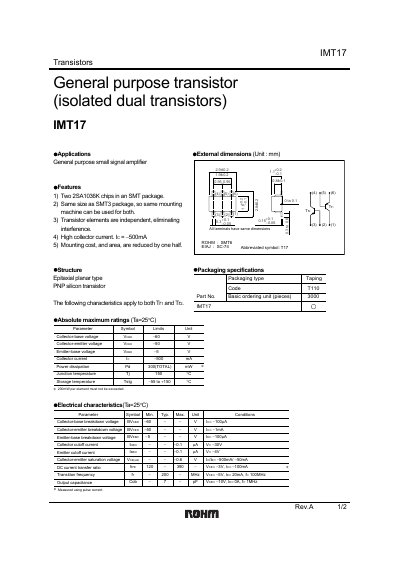
The IMT17 is a general‑purpose isolated dual transistor offered by ROHM. It features two 2SA1036K chips in an SMT package, independent transistor elements, high collector current capability, and reduced mounting cost and area.
The document lists absolute maximum ratings, electrical characteristics, and characteristic curves such as collector‑emitter saturation voltage and current gain. It also includes packaging details, application circuit examples, and export control information for designers using the device.
| Maximum collector current (IC) | -500 mA |
|---|---|
| Collector‑base breakdown voltage (VCBO) | -60 V |
| Collector‑emitter breakdown voltage (VCEO) | -50 V |
| Emitter‑base breakdown voltage (VEBO) | -5 V |
| Power dissipation per element | 200 mW |
| Maximum junction temperature (Tj) | 150 °C |
The IMT17 can handle a maximum collector current of -500 mA.
The device’s absolute maximum ratings are VCBO -60 V, VCEO -50 V, and VEBO -5 V.
Each transistor element may dissipate up to 200 mW.