
2SB1709 is a low frequency amplifier driver with a large current and a low saturation voltage.
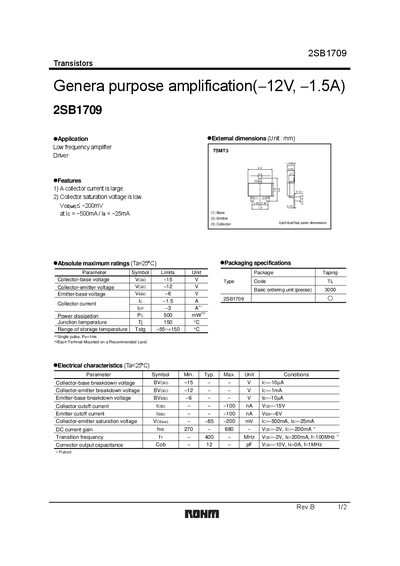
The 2SB1709 is a general‑purpose amplification transistor designed for low‑voltage, low‑current applications such as low‑frequency amplifiers and driver circuits. It features a large collector current capability and low collector saturation voltage.
Key specifications include a collector‑base voltage of –15 V, collector‑emitter voltage of 12 V, power dissipation of 500 mW, and a transition frequency of 400 MHz. The device is rated for a junction temperature up to 150 °C and can be stored between –55 °C and +150 °C. Electrical characteristic curves and maximum rating tables are provided for design reference.
| Collector‑base voltage (Vcbo) | -15 V |
|---|---|
| Collector‑emitter voltage (Vceo) | 12 V |
| Emitter‑base voltage (Vebo) | -6 V |
| Power dissipation (Pc) | 500 mW |
| Junction temperature (Tj) | 150 °C |
| DC current gain (hFE) | 270 – 680 |
| Transition frequency (fT) | 400 MHz |
| Collector‑emitter saturation voltage (Vce(sat)) | -200 mV |
The maximum collector‑emitter voltage is 12 V.
The device can dissipate up to 500 mW.
The transition frequency is specified as 400 MHz.