
RT, RTE Vishay Sfernice Wirewound Rheostats and Potentiometers Features: power range 12W to 500W, temperature range -20°C to 220°C, comply with CCTU 05-03B specification
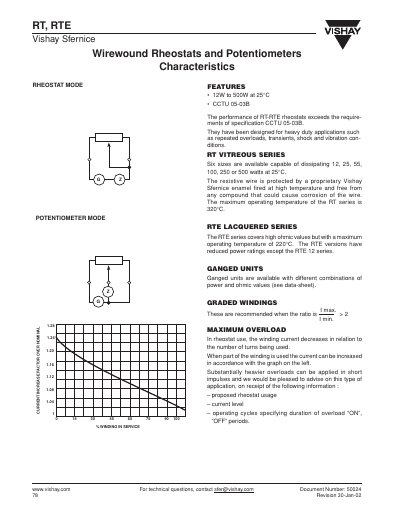
The RT and RTE series are wirewound rheostats and potentiometers designed for heavy‑duty applications such as repeated overloads, transients, shock and vibration. Six power‑rating sizes are offered, ranging from 12 W to 500 W at 25 °C, with the RT series tolerating up to 320 °C and the RTE series up to 220 °C.
The handbook details optional features such as ganged units, graded windings, double‑mini switches, and various shaft and lug configurations. It also describes overload capability, indicating that substantially heavier overloads can be applied in short impulses, and provides a current‑increase factor of up to 1.28 in potentiometer mode.
| Power dissipation range | 12 W to 500 W at 25 °C |
|---|---|
| Maximum operating temperature (RT series) | 320 °C |
| Maximum operating temperature (RTE series) | 220 °C |
| Available power‑rating sizes | 12, 25, 55, 100, 250 or 500 W |
| Current increase factor (potentiometer mode) | up to 1.28 over nominal |
The RT series can operate up to 320 °C.
Six sizes are offered: 12, 25, 55, 100, 250 or 500 W at 25 °C.
Yes, substantially heavier overloads can be applied in short impulses.