
This document is a specification sheet for C series ceramic capacitors. It mainly introduces the features and characteristics of the series capacitors, including precision technology, monolithic structure, high-precision automatic mounting, temperature characteristics, capacitance, voltage, external dimensions, etc.
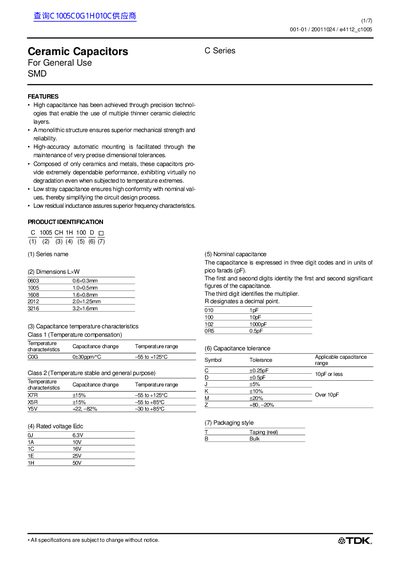
The handbook describes the C Series ceramic capacitors for general use in surface‑mount devices. It highlights high capacitance achieved by multiple thin dielectric layers, a monolithic structure for mechanical strength, and low stray capacitance for accurate circuit design.
Detailed tables list shapes and dimensions, capacitance ranges, temperature characteristic codes (X5R, X7R, Y5V, etc.), rated voltage options, tolerance values, and packaging styles. All specifications are subject to change without notice.
| Capacitance tolerance (Class 1) | ±30 ppm/°C |
|---|---|
| Rated voltage options | 6.3 V, 10 V, 16 V, 25 V, 50 V |
| Packaging style | Taping (reel) or Bulk |
| Low stray capacitance | Ensures high conformity with nominal values |
The C Series is available in Taping (reel) and Bulk packaging.
Rated voltages include 6.3 V, 10 V, 16 V, 25 V and 50 V.
Class 2 capacitors use X5R (+15 %), X7R (415 %), and Y5V (+22 %/‑82 %).