
The document describes the features and characteristics of the IL205AT/ IL206AT/ IL207AT/ IL208AT optocouplers, including high BVCEO, isolation test voltage, standard SOIC-8A package, suitable for surface mount equipment, and compliance with RoHS and WEEE standards.
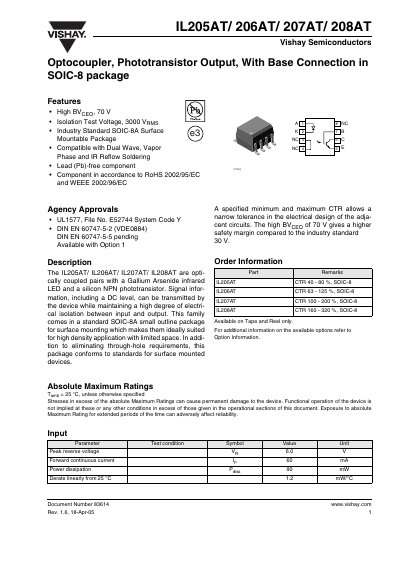
The IL205AT, IL206AT, IL207AT and IL208AT are optically coupled pairs featuring a GaAs infrared LED and a silicon NPN phototransistor in a SOIC‑8A package. The series offers high isolation (BVCEO 70 V, isolation test voltage 3000 VRMS) and a range of current transfer ratios (CTR) suited for high‑density surface‑mount applications.
The document provides absolute maximum ratings, electrical characteristics, typical switching behavior, package dimensions and compliance information such as RoHS and ozone‑depleting‑substance policies. It also includes legal disclaimer statements regarding product use and liability.
| Collector‑emitter breakdown voltage (BVCEO) | 70 V |
|---|---|
| Forward voltage (typical at 10 mA) | 1.3‑1.5 V |
| Power dissipation (LED + detector) | 150 mW |
| Total package dissipation (LED + detector) | 240 mW |
| Operating temperature range | -55 °C to +100 °C |
| Isolation test voltage | 3000 VRMS |
The collector‑emitter breakdown voltage (BVCEO) is specified as 70 V.
The typical forward voltage is between 1.3 V and 1.5 V at 10 mA.
The device is rated for an isolation test voltage of 3000 VRMS.
Yes, the components are listed as lead‑free and compliant with RoHS 2002/95/EC.