
The TFBS6711 is a low power IR transceiver from Vishay Semiconductors that supports data transmission rates from 9.6 kbit/s to 4 Mbit/s with a typical link distance of 50 cm. It also enables mobile phones and PDAs to function as universal remote controls for televisions, DVDs and other home appliances.
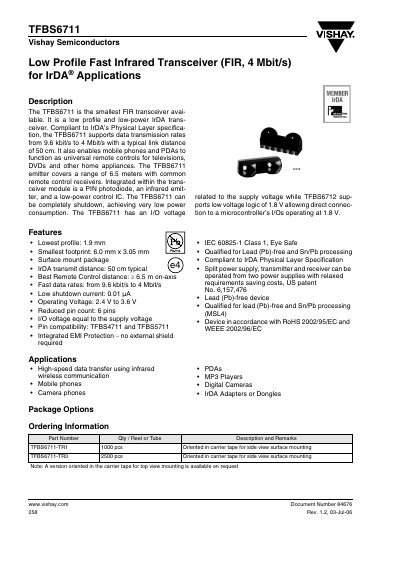
The TFBS6711 is a compact, low‑power infrared transceiver compliant with the IrDA Physical Layer specification. It integrates a PIN photodiode, an infrared emitter and a control IC in a 1.9 mm high, 6.0 mm × 3.05 mm footprint package, making it suitable for mobile phones, PDAs and remote‑control applications.
The device operates from 2.4 V to 3.6 V, draws only 0.01 µA in shutdown, and can transmit up to 6.5 m on‑axis. Detailed electrical and optoelectronic characteristics, recommended circuit diagrams, mode‑switching procedures, and soldering guidelines are provided for designers.
| Profile height | 1.9 mm |
|---|---|
| Footprint | 6.0 mm x 3.05 mm |
| Operating voltage | 2.4 V to 3.6 V |
| Shutdown current | 0.01 µA |
| Data rates | 9.6 kbit/s to 4 Mbit/s |
| Typical link distance | 50 cm |
| Remote‑control distance | ≥ 6.5 m on‑axis |
The typical link distance is 50 cm.
The shutdown current is 0.01 µA.
It operates from 2.4 V to 3.6 V.