
The MCP41XX and MCP42XX devices offer a wide range of product offerings using an SPI interface. This family of devices support 7-bit and 8-bit resistor networks, and Potentiometer and Rheostat pinouts.
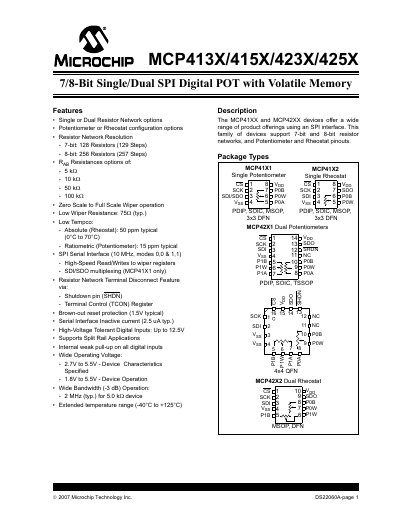
The MCP413X/415X/423X/425X family provides 7‑bit or 8‑bit SPI digital potentiometers and rheostats with selectable resistor network values (5 kΩ, 10 kΩ, 50 kΩ, 100 kΩ). Features include low wiper resistance, high‑speed SPI operation, brown‑out reset protection, and wide operating voltage ranges.
The document details electrical and AC/DC characteristics, package options (PDIP, SOIC, MSOP, DFN, QFN), and standard operating conditions such as supply voltage (2.7 V‑5.5 V) and temperature range (‑40 °C to +125 °C). It also includes notes on code protection and compliance information.
| Resolution | 7‑bit 128 Resistors (129 Steps) / 8‑bit 256 Resistors (257 Steps) |
|---|---|
| Supply Voltage (Operating) | 2.7 V to 5.5 V |
| Operating Temperature | -40 °C to +125 °C |
| Maximum Input Voltage (Digital Inputs) | Up to 12.5 V |
The devices operate from 2.7 V to 5.5 V.
They are rated for temperatures from –40 °C to +125 °C.
The 8‑bit version provides 256 resistors (257 steps).