
TLL.440 is a low power LED produced by Vishay Telefunken. It has high brightness, CMOS/MOS compatibility and other features. It is suitable for low power DC circuits.
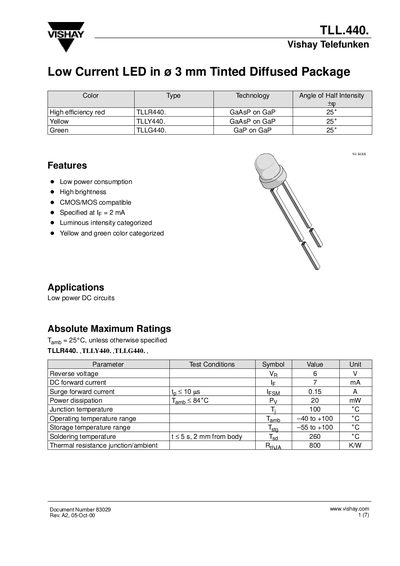
The TLL.440 family consists of low‑current 3 mm tinted diffused LEDs in red (TLLR440), yellow (TLLY440) and green (TLLG440) versions. They feature low power consumption, high brightness, and CMOS/MOS compatibility, making them suitable for low‑power DC circuits.
The document lists detailed electrical characteristics (forward voltage, reverse voltage, forward current, luminous intensity, wavelength), absolute maximum ratings, typical performance curves, mechanical dimensions, and Vishay’s ozone‑depleting substances policy. All parameters are given for a test current of 2 mA unless otherwise noted.
| Reverse voltage (Va) | 6 V |
|---|---|
| DC forward current (If) | 7 mA |
| Surge forward current (Ip) | 0.15 A |
| Junction temperature (Tj) | 100 °C |
| Operating temperature range | -40 °C to +100 °C |
| Storage temperature range | -55 °C to +100 °C |
| Thermal resistance (RJA) | 800 K/W |
The maximum reverse voltage is 6 V.
The LEDs are rated for operation from –40 °C to +100 °C.
Yes, they are listed as CMOS/MOS compatible.
Vishay certifies that its semiconductors, including the TLL.440 LEDs, are not manufactured with ozone‑depleting substances.