
MERCURY 100 User Manual, introduces the features and characteristics of the product, including basic parameters, usage methods, troubleshooting, etc.
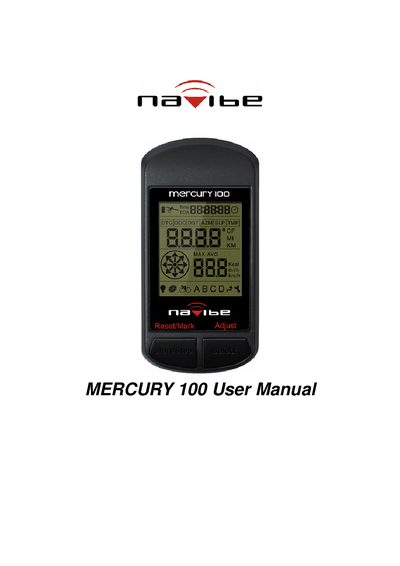
The Mercury 100 is a compact, lightweight GPS device designed for recreational cycling. It offers basic navigation functions such as Bike, Waypoint, and Route modes, and includes a rechargeable lithium battery, USB interface, and an internal antenna.
The manual covers package contents, hardware overview, system requirements, installation steps for the device cradle and software, detailed operation instructions, setup mode adjustments, and a troubleshooting guide to resolve common issues like power or satellite detection problems.
| Interface | USB Interface (can connect to PC) |
|---|---|
| Graphical Display | 32x38.25 mm |
| Receiver Chip | High sensitivity receiver chip |
| Hot Start Time | < 1 sec |
| Warm Start Time | < 38 sec |
| Cold Start Time | < 42 sec |
| Data Refresh Rate | Once every second |
| Antenna | Internal |
| Battery Type | Rechargeable Lithium Battery (820 mAh) |
| Battery Endurance | 20 hours under normal use with backlight off |
| Size | 91.1 mm (L) × 46.1 mm (W) × 23.9 mm (D) |
| Mass | < 100 g |
| Water Resistance | IPX7 (up to 1 m for 30 min) |
| Operating Temperature Range | -10 °C to +60 °C |
It takes 4–5 hours to fully recharge the battery.
The device operates between -10 °C and +60 °C.
A fully charged Mercury 100 can operate up to 20 hours with normal use and the backlight turned off.
The device must scan and detect signals from at least three satellites.