
The ADG333A is a monolithic CMOS device comprising four independently selectable SPDT switches. It is designed with low power dissipation, high switching speed, and low on resistance. It is suitable for applications such as audio and video switching, battery-powered systems, test equipment, and communication systems.
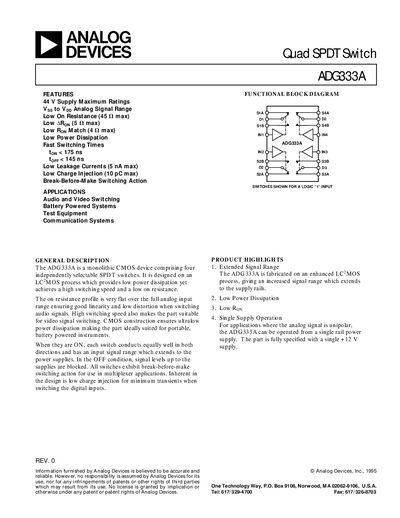
The ADG333A quad SPDT switch is designed on an LC°MOS process for low power dissipation and high switching speed. It offers a flat on‑resistance profile across the full analog input range, making it suitable for audio and video signal routing, as well as battery‑powered test equipment.
The device can be powered from a dual supply (±15 V typical) or a single +12 V supply, supports break‑before‑make switching, and includes ESD protection. Detailed specifications cover on‑resistance, leakage currents, switching times, charge injection, and absolute maximum ratings.
| Supply Voltage (dual) | Vpp = +15 V, Veg = –15 V |
|---|---|
| Supply Voltage (single) | Vin = +12 V |
| On‑Resistance (Ron) typical | 20 Ω |
| Switching time (ton) typical | < 175 ns |
| Power consumption (typical) | 0.05 mA |
The typical on‑resistance is 20 Ω.
First apply Vpp, then Vss, and finally the logic signals.
Yes, it can operate from a single +12 V supply.