
The ADM488A and ADM489A are low power, differential line transceivers suitable for communication on multipoint bus transmission lines. They are intended for balanced data transmission and comply with both RS-485 and RS-422 standards of the Electronics Industries Association (EIA).
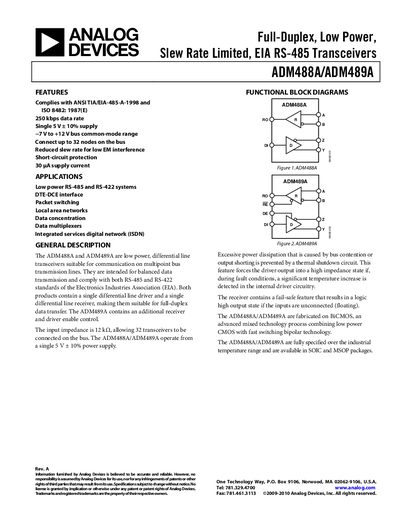
The ADM488A and ADM489A are low‑power, full‑duplex differential line transceivers that meet RS‑485 and RS‑422 standards. They operate from a single 5 V + 10 % supply and support up to 32 nodes on a bus, with features such as reduced slew rate, short‑circuit protection and thermal shutdown.
The document provides detailed electrical specifications, timing parameters, absolute maximum ratings, pin configurations for SOIC and MSOP packages, and an ordering guide for the various temperature‑rated part numbers.
| Supply voltage | 5 V + 10 % |
|---|---|
| Maximum data rate | 250 kbps |
| Input impedance | 12 kΩ |
| Supply current (outputs unloaded) | 30 µA |
| Operating temperature range (industrial) | -40 °C to +85 °C |
The ADM488A supports a maximum data rate of 250 kbps.
The device operates from a single 5 V + 10 % supply.
Up to 32 transceivers can be connected on the bus.
The input impedance is 12 kΩ.