
The ADN2892 is a 4.25 Gbps limiting amplifier with integrated loss of signal (LOS) detection circuitry and a received signal strength indicator (RSSI). This part is op
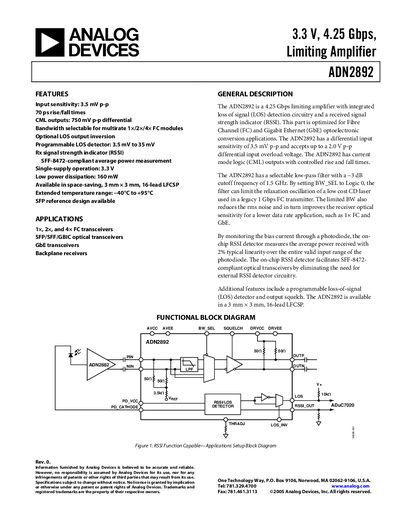
The ADN2892 limiting amplifier is optimized for Fibre Channel and Gigabit Ethernet optoelectronic conversion. It integrates loss‑of‑signal (LOS) detection and a received‑signal‑strength indicator (RSSI) to simplify SFF‑8472‑compliant transceiver designs. The device supports 1×, 2× and 4× FC data rates and offers selectable bandwidth for multirate applications.
Key features include a 3.5 mV p‑p input sensitivity, 70 ps rise/fall times, 160 mW typical power dissipation, and a compact 3 mm × 3 mm 16‑lead LFCSP package. Electrical specifications cover a 2.9 V–3.6 V supply range, –40 °C to +95 °C operating temperature, and 50 Ω differential output impedance.
| Input Sensitivity | 3.5 mV p‑p |
|---|---|
| Input Data Rate | 4.25 Gbps |
| Output Voltage Swing | 600 – 940 Vp‑p differential |
| Supply Voltage | 2.9 V – 3.6 V |
| Operating Temperature Range | ‑40 °C to +95 °C |
| Package | 3 mm × 3 mm 16‑lead LFCSP |
The ADN2892 has an input sensitivity of 3.5 mV peak‑to‑peak.
It operates from 2.9 V to 3.6 V supply voltage.
The device is offered in a 3 mm × 3 mm 16‑lead LFCSP package.