
The ADN3000-06 is a complete high speed optical receiver featuring a proprietary large-area germanium PIN photodiode integrated with a transimpedance amplifier (TIA). The integrated photodiode and TIA improve the performance of the optical receiver.
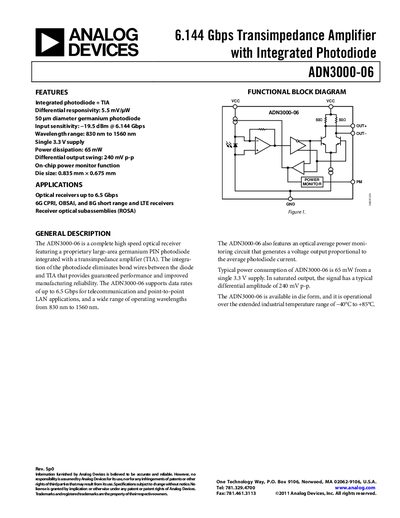
The ADN3000-06 is a high‑speed optical receiver that integrates a large‑area germanium PIN photodiode with a transimpedance amplifier (TIA). It provides a differential responsivity of 5.5 mV/pW, a single 3.3 V supply, and typical power dissipation of 65 mW, delivering a differential output swing of 240 mV p‑p.
Designed for data rates up to 6.5 Gbps, the device operates over a wavelength range of 830 nm to 1560 nm and is suitable for 6G CPRI, OBSAI, 8G short‑range, LTE receivers, and receiver optical sub‑assemblies (ROSA). It is available in die form and operates from –40 °C to +85 °C.
| Differential responsivity | 5.5 mV/pW |
|---|---|
| Photodiode diameter | 50 pm |
| Input sensitivity | ‑19.5 dBm @ 6.144 Gbps |
| Wavelength range | 830 nm to 1560 nm |
| Supply voltage | Single 3.3 V |
| Power dissipation | 65 mW |
| Differential output swing | 240 mV p‑p |
| Die size | 0.835 mm x 0.675 mm |
| Operating temperature range | ‑40 °C to +85 °C |
The input sensitivity is ‑19.5 dBm at a data rate of 6.144 Gbps.
Typical power consumption is 65 mW from a single 3.3 V supply.
It supports wavelengths from 830 nm to 1560 nm.