
The FX469 is a CML Semiconductor product. It is a single-chip CMOS LSI circuit that operates at 1200, 2400 or 4800 baud, with a choice of full-duplex pin. This device is low-power and requires few external components, and provides S.O.I.C and cerdip DIL packages.
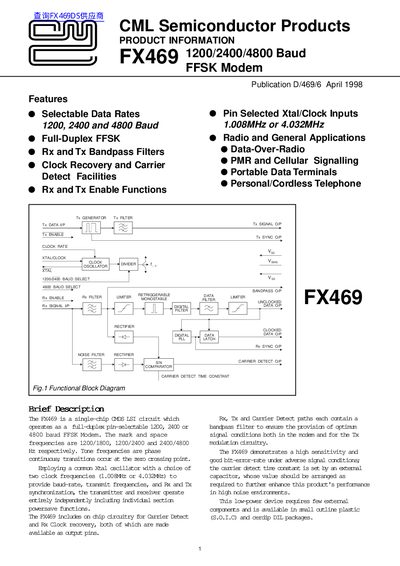
The FX469 is a single‑chip full‑duplex FFSK modem that operates at selectable data rates of 1200, 2400 or 4800 baud. It uses a pin‑selectable crystal oscillator (1.008 MHz or 4.032 MHz) to generate the required transmit and receive frequencies, and provides on‑chip carrier‑detect and clock‑recovery functions.
The device is offered in several plastic and ceramic packages (20‑pin, 22‑pin, 24‑pin) and requires a single 5 V supply. Detailed pin descriptions, timing diagrams, and electrical specifications are provided for designers integrating the modem into radio, data‑over‑radio, or portable terminal applications.
| Supply voltage | -0.3 to 7.0 V |
|---|---|
| Supply current (Rx enabled, Tx disabled) | 3.6 mA |
| Logic ‘1’ output level | 4.0 V |
| Tx output level | 775 mVrms |
| Clock frequency options | 1.008 MHz or 4.032 MHz |
The FX469 supports selectable data rates of 1200, 2400 and 4800 baud.
The device can be driven by a 1.008 MHz or a 4.032 MHz crystal/clock.
The FX469 operates with a supply voltage ranging from –0.3 V to 7.0 V.