
This document introduces the GIGABYTE A75 chipset overclocking guide, which offers some interesting overclocking abilities and impressive 3D performance boost. The platform has decent potential to make a great all rounder/home media PC, office machine, even a gaming machine on a budget.
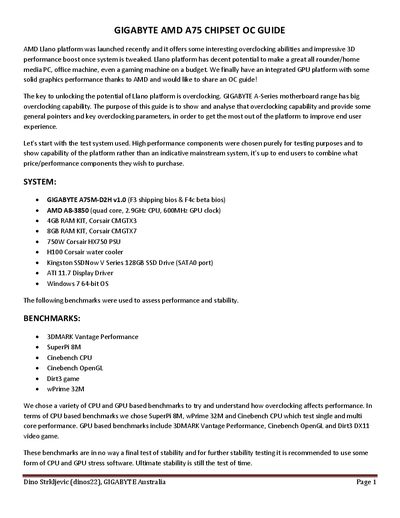
The document provides an overclocking guide for the AMD Llano platform using a Gigabyte A75M-D2H motherboard. It describes the test system, benchmarks, and the methodology for increasing CPU, memory, and GPU frequencies by adjusting the base clock (bclock) and related voltages.
Key sections cover basic OC parameters, memory divider calculations, timing adjustments, voltage tuning, graphics settings used for testing, and final performance results. The guide also offers practical tips such as disabling SATA AHCI for higher bclock stability and forcing Windows power options to maximum performance.
| CPU Model | AMD A8-3850 (quad core, 2.9GHz) |
|---|---|
| Motherboard Model | Gigabyte A75M-D2H v1.0 |
| Maximum RAM frequency (BIOS) | 2593 MHz |
| Maximum bclock | 161 MHz |
| Test Power Supply | Corsair HX750 750 W |
The guide reports a maximum bclock of 161 MHz in the BIOS settings.
After increasing memory ratios, loosen the timings in the DRAM Configuration menu, e.g., change from 6‑6‑6‑18 to 8‑8‑8‑27 or 10‑10‑10‑30.