
This chip is a high-performance low-power AVR® 8-bit microcontroller
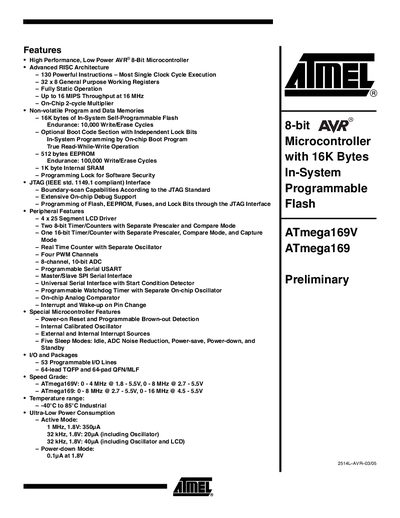
The ATmega169 is a low‑power CMOS 8‑bit microcontroller based on the AVR enhanced RISC architecture. It offers up to 16 MIPS throughput at 16 MHz, 16 KB of in‑system programmable Flash, 512 B EEPROM, 1 KB SRAM, and 53 programmable I/O lines. The device includes a rich peripheral set: four PWM channels, an 8‑channel 10‑bit ADC, three timer/counters (two 8‑bit, one 16‑bit), a programmable watchdog, JTAG interface, and an on‑chip LCD driver.
The datasheet details the pin‑out for 64‑lead TQFP and 64‑pad QFN/MLF packages, power‑saving modes (Idle, Power‑down, Power‑save, Standby), speed grades, temperature range (-40 °C to 85 °C), and typical ultra‑low power consumption figures. It also describes the core CPU, register file, ALU operation, and memory map, providing designers with the information needed to integrate the ATmega169 into embedded applications.
| Flash Memory | 16 KB |
|---|---|
| EEPROM | 512 B |
| SRAM | 1 KB |
| General‑purpose I/O lines | 53 |
| ADC | 8‑channel, 10‑bit |
| PWM Channels | 4 |
| Speed Grade (ATmega169V) | 0‑4 MHz @ 1.8‑5.5 V, 0‑8 MHz @ 2.7‑5.5 V |
| Operating Temperature Range | -40 °C to 85 °C (Industrial) |
| Package Types | 64‑lead TQFP, 64‑pad QFN/MLF |
The ATmega169 provides 16 KB of in‑system self‑programmable Flash memory.
The device offers 53 programmable I/O lines.
It includes an 8‑channel, 10‑bit analog‑to‑digital converter.
ATmega169V operates from 0‑4 MHz at 1.8‑5.5 V and 0‑8 MHz at 2.7‑5.5 V.