
The ZH connector is a connector with a compact and low profile design. Its features include a mounting height of 5.6mm and a thickness of only 3.5mm; contact retention lances on the housing make insertion easier; the dimple at the center of the contact ensures reliable contact. The connector is suitable for applications with a current rating of 1.0A and a voltage rating of 50V.
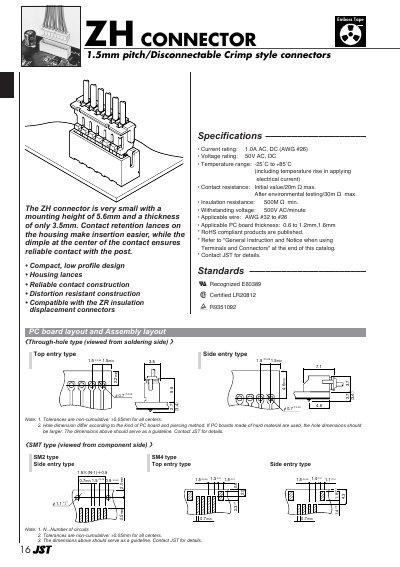
The JST ZH connector is a compact, low‑profile through‑hole and surface‑mount part with a mounting height of 5.6 mm and a thickness of 3.5 mm. It features housing lances for easy insertion and a central dimple for reliable contact.
The document provides current and voltage ratings, temperature range, insulation resistance, applicable wire sizes, PCB thickness, material finishes, and detailed taping and feeding specifications for various circuit counts.
| Current rating | 1.0 A AC, DC (AWG #26) |
|---|---|
| Voltage rating | 50 V AC, DC |
| Temperature range | -25 °C to +85 °C |
| Insulation resistance | ≥ 500 MΩ min. |
| Withstanding voltage | 500 V AC/minute |
| Applicable PCB thickness | 0.6 mm to 1.6 mm |
| Mounting height | 5.6 mm |
| Connector thickness | 3.5 mm |
It is rated for 1.0 A AC and DC (AWG #26).
The connector is rated for up to 50 V AC or DC.
It operates from –25 °C to +85 °C, including temperature rise from current.