
The Rosemount 3300 Series is a core component of the PlantWeb digital plant architecture, consisting of smart, loop-powered level and interface transmitters based on guided wave radar technology. These transmitters provide reliable measurements on liquids and slurries even in severe conditions, thanks to advanced signal processing, digital sampling, and high signal-to-noise ratio.
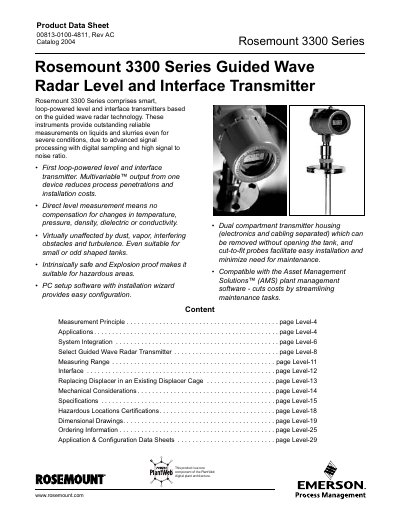
The Rosemount 3300 Series includes loop‑powered guided wave radar transmitters for level and interface measurement in liquids, slurries and hazardous environments. The devices use Time Domain Reflectometry (TDR) to convert radar pulse reflections into level data, providing reliable performance even in turbulent or dusty conditions.
The data sheet covers measurement principle, system integration, probe options, specifications, hazardous‑location certifications and ordering information, helping engineers select and configure the appropriate model (3301 or 3302) for their application.
| Input voltage | 11‑42 VDC (11‑30 VDC in IS, 16‑42 VDC in Explosion Proof) |
|---|---|
| Output signal | Analog 4‑20 mA with superimposed digital HART® |
| Microwave output power | Nominal 50 µW, Max 2.0 mW |
| Damping time | 0‑60 s (default 10 s) |
| Loop‑powered wiring | Two‑wire (power and signal share same pair) |
It uses Time Domain Reflectometry (TDR) guided wave radar, sending microwave pulses down a probe and measuring the reflected signal to calculate level.
The transmitter operates from 11‑42 VDC (11‑30 VDC in intrinsically safe mode, 16‑42 VDC in explosion‑proof mode).
The device is loop‑powered, using a two‑wire pair for both power supply and the 4‑20 mA/HART signal.
It provides an analog 4‑20 mA current loop with a superimposed digital HART® signal for remote configuration.