
M27W101 is a low power, low voltage 1 Mbit EPROM that is ideal for microprocessor systems that require large data or program storage. It is organized as 131,072 by 8 bits and can be read with a supply voltage as low as 2.7V in the temperature range of -40 to 85 °C.
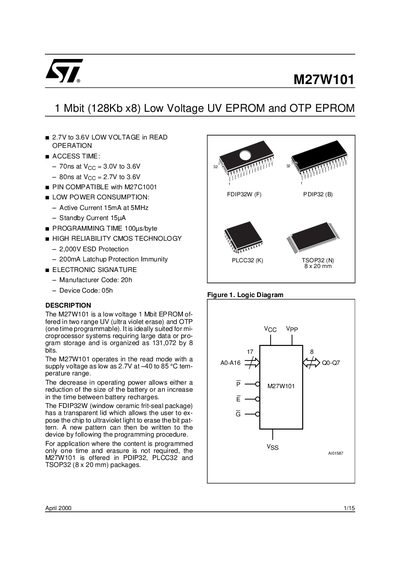
The M27W101 is a 1 Mbit (128 Kb × 8) low‑voltage EPROM offered in UV‑erase and one‑time‑programmable (OTP) versions. It operates from 2.7 V to 3.6 V and is pin‑compatible with the M27C1001, making it suitable for microprocessor systems that need large, non‑volatile storage.
The document provides absolute maximum ratings, read and programming mode characteristics, timing diagrams, and mechanical data for the FDIP32, PDIP32, PLCC32, and TSOP32 packages. It also describes the programming algorithm, standby power reduction, and recommended decoupling practices for system designers.
| Memory size | 1 Mbit (128 Kb × 8) |
|---|---|
| Supply voltage (Voc) | 2.7 V to 3.6 V |
| Access time | 70 ns at 3.0 V‑3.6 V |
| Active current (5 MHz) | 15 mA |
| Standby current | 15 µA |
| Programming time | 100 µs/byte |
| ESD protection | 2000 V |
| Latchup protection | 200 mA |
Programming requires Vpp = 12.75 V and Vcc = 6.25 V.
The standby current is 15 µA.
The device operates from –40 °C to 85 °C.