
TH72016 is a 433MHz FSK/ASK transmitter with a fully integrated PLL-stabilized VCO, a frequency range from 380 MHz to 450 MHz, a single-ended RF output, FSK modulation from DC to 40 kbit/s through crystal pulling, high FSK deviation for wideband data transmission, ASK modulation achieved by on/off keying of internal power amplifier up to 40 kbit/s, a wide power supply range from 1.95 V to 5.5 V, very low standby current, a microcontroller clock output, an on-chip low voltage detector, high overall frequency accuracy, independently adjustable FSK deviation and center frequency, adjustable output power range from -12 dBm to +10 dBm, adjustable current consumption from 3.8 mA to 11.0 mA, conforms to EN 300 220 and similar standards, and comes in a 10-pin Quad Flat No-Lead Package (QFN).
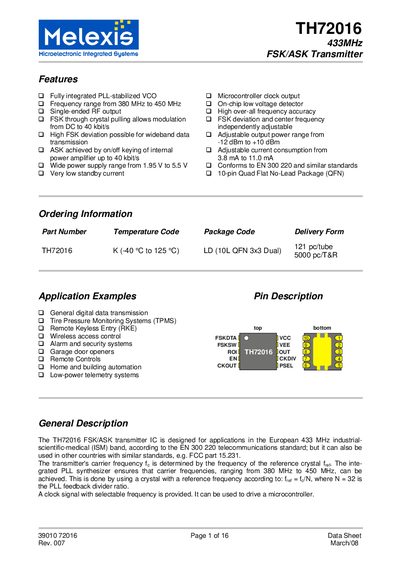
The TH72016 is a fully integrated 433 MHz FSK/ASK transmitter designed for ISM‑band applications such as TPMS, remote keyless entry, and low‑power telemetry. It features a PLL‑stabilized VCO, on‑chip low‑voltage detector, and four selectable output‑power steps from –12 dBm to +10 dBm.
The device operates from 1.95 V to 5.5 V, supports data rates up to 40 kbit/s, and provides a CMOS‑compatible clock output (CKOUT) that can be divided by 4 or 16. Pin functions include FSK data input, power‑select, mode control, and an open‑collector PA output.