
This document describes the features and characteristics of the M25P05-A 512-Kbit serial flash memory, including flash memory capacity, programming and erasing speed, supply voltage, and serial interface.
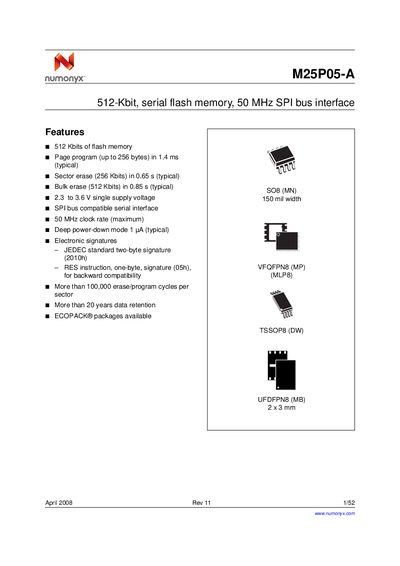
The M25P05-A is a 512‑Kbit (64 K×8) serial flash memory that operates over a 2.3 V to 3.6 V supply range and supports a 50 MHz SPI bus. It offers page programming up to 256 bytes, sector and bulk erase functions, and a deep‑power‑down mode for low‑power applications.
The device includes advanced write‑protect mechanisms, more than 100 k erase/program cycles per sector, and a data retention guarantee of over 20 years. It is available in several compact packages such as SO8, VFQFPN8, TSSOP8 and UFDFPN8.
| Memory size | 512 Kbit |
|---|---|
| SPI clock rate | 50 MHz (maximum) |
| Page program time | 1.4 ms (typical) for up to 256 bytes |
| Bulk erase time | 0.85 s (typical) for 512 Kbits |
| Supply voltage | 2.3 V to 3.6 V |
| Deep power‑down current | 1 µA (typical) |
| Erase/program cycles | >100 000 per sector |
| Data retention | >20 years |
It operates from 2.3 V to 3.6 V single supply voltage.
The device supports up to a 50 MHz SPI clock rate.
Each sector can handle more than 100 000 erase/program cycles.
Data retention is guaranteed for more than 20 years.