
VLWW960 is a high-end LED product launched by Vishay Semiconductors. It uses InGaN technology and has the characteristics of high luminous flux and high heat dissipation. It is suitable for automotive tail lights, instrument panel lighting and other application scenarios
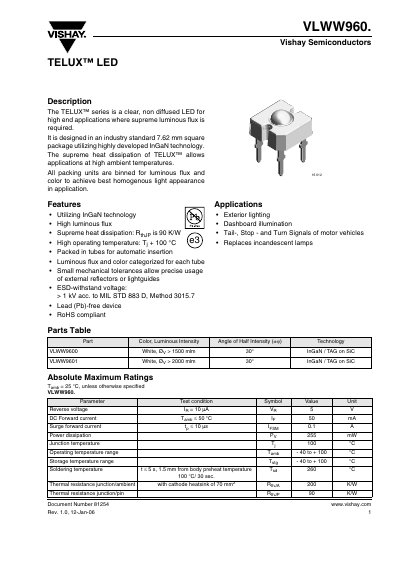
The VLWW960 is a clear, non‑diffused LED in a 7.62 mm square package using InGaN technology. It offers high luminous flux, excellent heat dissipation (RthJP = 90 K/W) and can operate at junction temperatures up to 100 °C. The device is RoHS‑compliant, lead‑free and rated for an ESD withstand voltage above 1 kV.
Typical applications include exterior lighting, dashboard illumination and vehicle signal lights. The datasheet provides absolute maximum ratings, optical and electrical characteristics, package dimensions, and regulatory information such as ozone‑depleting substances policy and legal disclaimer.
| Luminous Flux (VLWW9600) | 1500‑2200 mlm |
|---|---|
| Luminous Flux (VLWW9601) | 2000‑3600 mlm |
| Forward Voltage (IF = 50 mA) | 4.3‑5.2 V |
| Thermal Resistance (junction‑to‑pin) | 90 K/W |
| Operating Temperature Range | -40 °C to +100 °C |
| Junction Temperature (Tj) | 100 °C |
The forward voltage at 50 mA is between 4.3 V and 5.2 V.
It can operate from –40 °C up to +100 °C ambient temperature.
Yes, the device is RoHS compliant and lead‑free.
The thermal resistance is 200 K/W (junction‑to‑ambient).