
IPD50R520CP is a power transistor. It features the lowest RONxQg, ultra low gate charge, extreme dv/dt rating, high peak current capability, lead-free lead plating, RoHS compliant and qualified according to JEDEC1) for target applications.
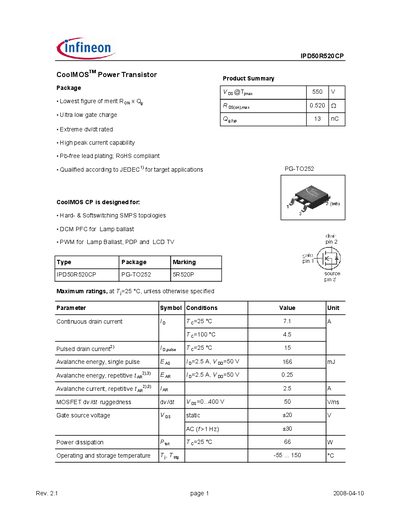
The IPD50R520CP is a CoolMOS™ power transistor offered in a PG‑TO252 (D‑PAK) package. It is designed for hard‑ and soft‑switching SMPS topologies, lamp ballast, PWM for LCD TV, and other high‑frequency applications. The device features ultra‑low gate charge, high peak current capability, and is RoHS compliant.
Key electrical parameters include a continuous drain current of 7.1 A, pulsed drain current of 15 A, on‑state resistance of 0.47 Ω (typ) to 0.52 Ω (max), and avalanche energy of 166 mJ for a single pulse. Thermal resistance, capacitances, and switching times are also detailed, along with package dimensions and safety information.
| Continuous drain current (Id) | 7.1 A |
|---|---|
| Pulsed drain current (Id,pulse) | 15 A |
| On‑state resistance (Rds(on)) | 0.47 Ω typ / 0.52 Ω max |
| Output capacitance (Coss) | 31 pF |
| Turn‑on delay time | 35 ns |
| Rise time | 14 ns |
The maximum continuous drain current is 7.1 A at 25 °C.
Typical on‑state resistance is 0.47 Ω and maximum is 0.52 Ω at Vgs = 10 V, Id = 3.8 A.