
The MCP4021/2/3/4 is Microchip's 6-bit resolution non-volatile digital potentiometer that can be configured as either a potentiometer or a rheostat. The wiper setting is controlled via a simple Up/Down (U/D) serial interface. These devices utilize Microchip's WiperLock technology, which allows application-specific calibration settings to be stored in EEPROM without the use of additional write protect pins.
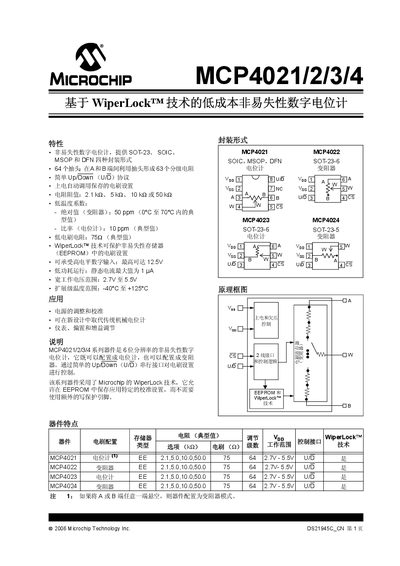
The MCP4021/2/3/4 series are low‑cost, non‑volatile digital potentiometers based on WiperLock™ technology. They are available in four package types (SOT‑23‑6, SOIC, MSOP, DFN) and can be configured as either a potentiometer or a variable resistor. The devices use a simple UP/DOWN serial interface to control the wiper position and store calibration data in an internal EEPROM.
The datasheet lists the electrical specifications, including a supply voltage range of 2.7 V to 5.5 V, a static current of up to 1 µA, and an operating temperature range of –40 °C to +125 °C. Each device offers 64 taps with resistance options of 2.1 kΩ, 5 kΩ, 10 kΩ, or 50 kΩ, and features low temperature coefficients and low brush resistance. This manual is written in Chinese.
| Operating temperature range | –40 °C to +125 °C |
|---|---|
| Maximum input high voltage | 12.5 V |
The device can tolerate up to 12.5 V on the input high level.