
TLE 6254-2G is a differential CAN transceiver for low-speed data transmission in automotive and industrial applications. When no data is transferred, the power consumption can be minimized by multiple low power modes. In normal operation mode a differential signal is transmitted/received. When bus wiring failures are detected the device automatically switches in a dedicated single-wire mode to maintain communication.
The TLE 6254-2G transceiver provides a robust interface between a CAN controller and the physical CAN bus, supporting data rates up to 125 kBaud and optimized for automotive and industrial applications. It features multiple low‑power operation modes, a wake‑up input, battery‑fail flag, and extended bus‑failure management to maintain communication during line failures.
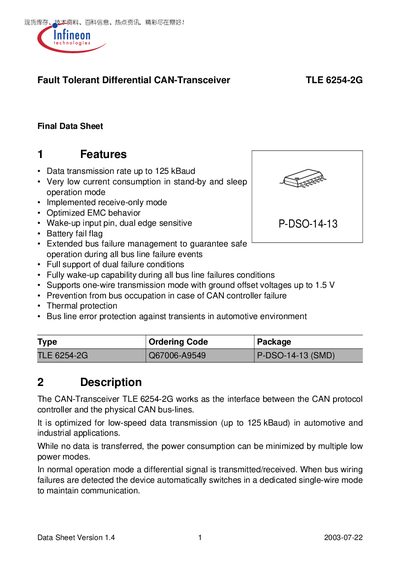
The device is supplied in a P‑DSO‑14‑13 package and includes pins for inhibit output, transmit/receive data, error flag, standby, enable, wake‑up, termination resistors, supply voltages, and CAN bus lines. Functional block diagrams, pin definitions, and operation mode truth tables are provided for design integration.
| Maximum data transmission rate | 125 kBaud |
|---|---|
| Current consumption in standby and sleep | Very low |
| Wake‑up input pin | Pin 7 (WK) |
| Battery fail flag | Provided |
| One‑wire transmission mode voltage offset | up to 1.5 V |
| Thermal protection | Included |
| Bus line error protection (automotive environment) | Included |
The transceiver supports data rates up to 125 kBaud.
Pin 7 (WK) is the wake‑up input pin.