
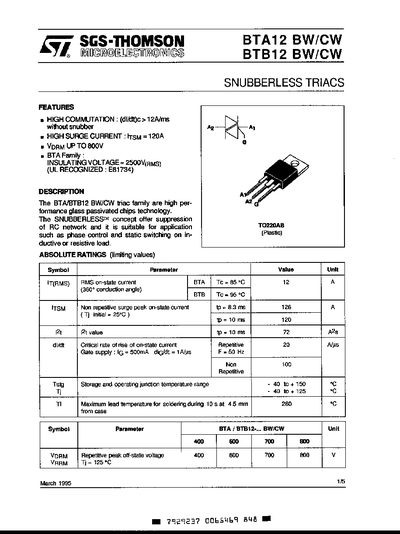
The BTA12 BW/CW and BTB12 BW/CW are snubberless triacs from the SGS‑Thomson family, featuring high commutation speed and high surge current capability without the need for external snubber networks. They are intended for phase‑control and static‑switching applications with resistive, inductive or capacitive loads.
The document provides detailed absolute ratings, thermal resistance data, gate and electrical characteristics, ordering information and mechanical dimensions for the TO220AB plastic package. Key parameters such as on‑state RMS current, peak surge current, off‑state voltage rating and recommended mounting torque are listed for design reference.
| Peak off‑state voltage (VDRM) | 800 V |
|---|---|
| Junction‑to‑case thermal resistance (BTA) | 33 °C·W |
| Package type | TO220AB Plastic |
| Operating temperature range | -40 °C to +150 °C |
| Recommended mounting torque | 0.8 m·N |
| Maximum mounting torque | 1 m·N |
| Weight | 2.39 g |
| Gate trigger voltage (VGT) | 12 V |
The devices are rated for a repetitive peak off‑state voltage of 800 V.
Both devices are supplied in a TO220AB plastic package.
A recommended torque of 0.8 m·N (maximum 1 m·N) should be used.