
L6562 is a transition-mode PFC controller from Texas Instruments. The device is manufactured in BCD technology and features low startup current, low quiescent current, extended IC supply voltage range, on-chip filter on current sense, disable function, 1% (@ Tj = 25°C) internal reference voltage, -600/+800mA totem pole gate driver with UVLO pull-down and voltage clamp. The device is used in PFC pre-regulators for IEC61000-3-2 compliant SMPS (TV, desktop PC, monitor) and other devices.
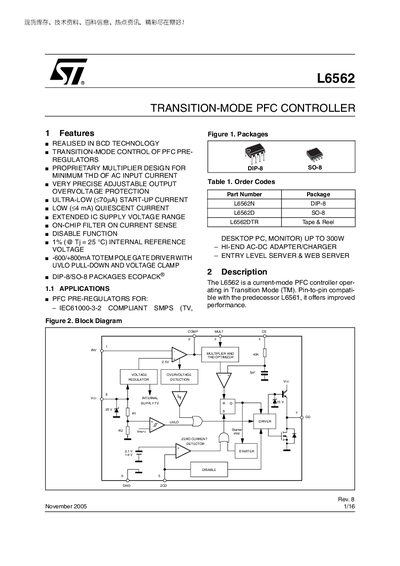
The L6562 is a current‑mode PFC controller operating in transition mode, designed for IEC‑61000‑3‑2 compliant SMPS up to 300 W. It offers low start‑up current, ultra‑low quiescent consumption, and an on‑chip filter for current sense.
The document provides a detailed description, pin functions, absolute maximum ratings, electrical characteristics, typical performance graphs, and application information such as over‑voltage protection and starter timing.
| Quiescent current (after turn‑on) | 2.5 mA – 3.75 mA |
|---|---|
| Output driver source current | 600 mA (source) / 800 mA (sink) |
The quiescent current after turn‑on is typically 2.5 mA, up to 3.75 mA.
The totem‑pole output stage can source up to 600 mA and sink up to 800 mA.