
The AD7660 is a 16-bit, 100 kSPS CMOS ADC with 16-bit resolution, no missing codes, 0 V to 2.5 V analog input voltage range, 5 V/3 V interface, and single 5 V supply operation.
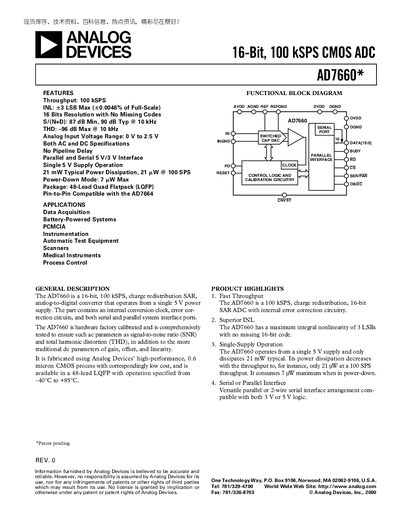
The AD7660 is a 16‑bit, 100 kSPS charge‑redistribution SAR ADC that operates from a single 5 V supply. It provides internal conversion clock, error‑correction circuitry, and both serial and parallel interfaces. Key features include 3 LSB maximum INL, 87 dB SNR, –96 dB THD, and typical power dissipation of 21 mW.
Typical applications are data acquisition, battery‑powered systems, PCMCIA, instrumentation, test equipment, scanners, medical instruments, and process control. The document also gives layout recommendations such as separating analog and digital ground planes and using proper decoupling capacitors.
| Resolution | 16 Bits |
|---|---|
| Throughput | 100 kSPS |
| Analog Input Voltage Range | 0 V to 2.5 V |
| Integral Nonlinearity (INL) | ±3 LSB |
| Total Harmonic Distortion (THD) | -96 dB max |
The AD7660 can convert at up to 100 kSPS.
It operates from a single 5 V supply.
In power‑down mode the device consumes a maximum of 7 pW.
The analog input range is 0 V to 2.5 V.