
AD7952 is a 14-bit, 1 MSPS, differential, programmable input PulSAR® ADC.
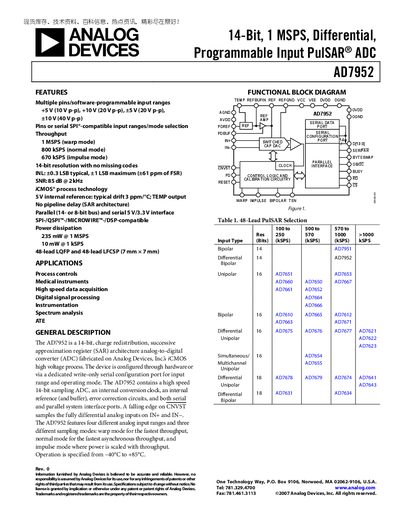
The AD7952 is a 14‑bit charge‑redistribution successive approximation register (SAR) analog‑to‑digital converter fabricated in Analog Devices' iCMOS high‑voltage process. It offers multiple programmable input ranges, three sampling modes (warp, normal, impulse), and operates from –40 °C to +85 °C. The device provides up to 1 MSPS throughput in warp mode and includes both parallel and serial (SPI/QSPI/MICROWIRE) interfaces.
The datasheet includes detailed specifications, timing diagrams, pin descriptions, absolute maximum ratings, and layout guidelines. Recommended PCB practices separate analog and digital ground planes, use star grounding, and place decoupling capacitors close to power pins to minimize noise and ensure reliable performance.
| Resolution | 14 bits |
|---|---|
| Input Voltage Ranges | +5 V (10 V p‑p), +10 V (20 V p‑p), +5 V (20 V p‑p), +10 V (40 V p‑p) |
| Operating Temperature Range | -40 °C to +85 °C |
| Signal‑to‑Noise Ratio | 85 dB @ 2 kHz |
The device supports +5 V (10 V p‑p), +10 V (20 V p‑p), +5 V (20 V p‑p), and +10 V (40 V p‑p) ranges.
Separate analog and digital ground planes should be used and joined at a single point near the AD7952.