
This document describes the basic features and use of the Atmel XMEGA USART, including polled mode, interrupt mode and DMAC mode
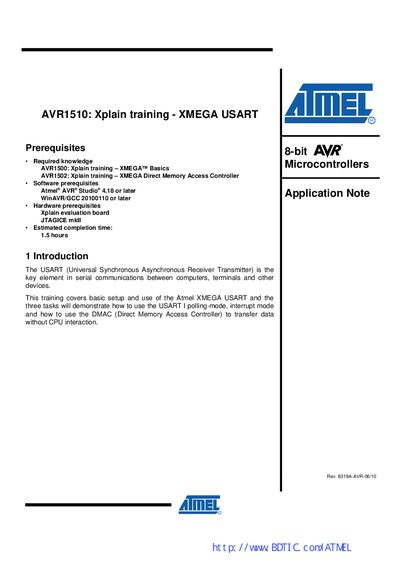
The AVR1510 training guide introduces the XMEGA USART and lists the required software (AVR Studio, WinAVR/GCC) and hardware (Xplain evaluation board, JTAGICE mkII). It also gives an estimated completion time of 1.5 hours.
Three hands‑on tasks are covered: Task 1 shows USART operation in polling mode, Task 2 demonstrates interrupt‑driven communication with a driver and ring buffer, and Task 3 explains how to use the DMA controller to transfer data without CPU intervention.
| Peripheral frequency (default) | 2 MHz |
|---|---|
| Hardware buffer size | three bytes |
You need the Xplain evaluation board and a JTAGICE mkII debugger.
BSEL is calculated from the peripheral frequency, BSCALE and the desired baud rate; with BSCALE set to 0 the formula is BSEL = (Fosc / (16 × Baud)) − 1.