
This is a PDF file about ATmega8A microcontroller. ATmega8A is a high performance, low power AVR® 8-bit microcontroller. It has advanced RISC architecture, 131 powerful instructions, most single clock cycle execution, 32 x 8 general purpose working registers, fully static operation, up to 20 MIPS throughput at 20 MHz, on-chip 2-cycle multiplier.
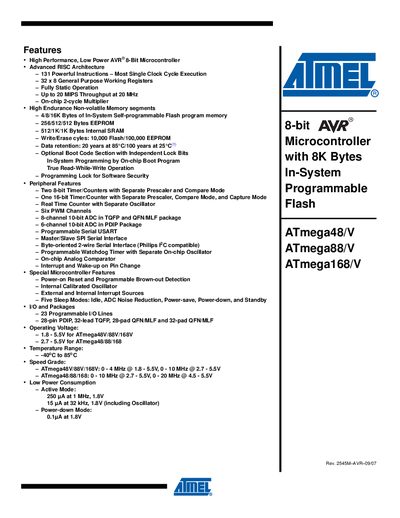
This manual describes the features, pin configurations, and functional blocks of the ATmega48, ATmega88 and ATmega168 microcontrollers. It includes a block diagram, detailed pin descriptions, electrical characteristics, and information on programming and power‑saving modes.
Additional sections cover development resources, data retention specifications, packaging information, errata, and revision history, along with contact details for technical support and sales.
| Operating Voltage | 1.8‑5.5 V (ATmega48V/88V/168V) / 2.7‑5.5 V (ATmega48/88/168) |
|---|---|
| Flash Memory | 4 KB / 8 KB / 16 KB (ATmega48 / ATmega88 / ATmega168) |
| EEPROM | 256 B / 512 B (ATmega48 / ATmega88 / ATmega168) |
| SRAM | 512 B / 1 KB (ATmega48 / ATmega88 / ATmega168) |
| I/O Lines | 23 programmable I/O lines |
| ADC Channels | 8‑channel 10‑bit ADC (TQFP/QFN/MLF) / 6‑channel 10‑bit ADC (PDIP) |
| Timers/Counters | Two 8‑bit and one 16‑bit Timer/Counters |
| Maximum Throughput | Up to 20 MIPS at 20 MHz |
| Temperature Range | -40 °C to 85 °C |
The ATmega48V/88V/168V versions operate from 1.8 V to 5.5 V, while the standard ATmega48/88/168 operate from 2.7 V to 5.5 V.
The ATmega168 includes 16 KB of In‑System Self‑programmable Flash memory.
All three devices provide 23 programmable I/O lines.
They are rated for operation from –40 °C up to 85 °C.