
This document describes a high-performance, low-power AVR® 8-bit microcontroller with advanced RISC architecture, non-volatile program and data memories, peripheral features, JTAG interface, and other characteristics.
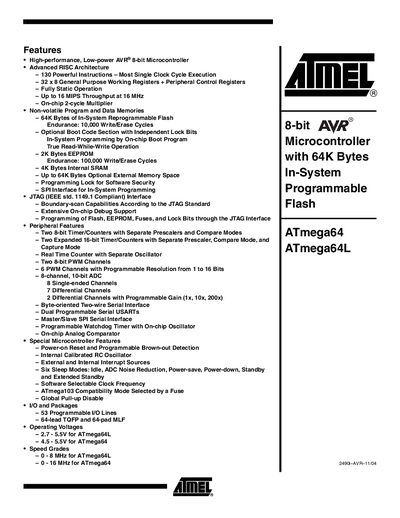
The ATmega64 and ATmega64L are low‑power 8‑bit AVR microcontrollers featuring up to 64 KB of in‑system programmable Flash, 2 KB EEPROM, 4 KB SRAM, and 53 programmable I/O lines. They include multiple timers, PWM channels, a 10‑bit ADC, dual USARTs, SPI, JTAG, and extensive low‑power modes.
The document details the device architecture, pin‑out for TQFP/MLF packages, voltage ranges (2.7‑5.5 V for ATmega64L, 4.5‑5.5 V for ATmega64), speed grades (0‑8 MHz for ATmega64L, 0‑16 MHz for ATmega64), and compatibility with ATmega103. It also covers reset behavior, programming interfaces, and peripheral functions.
| Flash Memory | 64 KB In‑System Reprogrammable Flash |
|---|---|
| EEPROM | 2 KB |
| SRAM | 4 KB |
| Programmable I/O Lines | 53 |
| ADC | 8‑channel, 10‑bit |
| Operating Voltage (ATmega64L) | 2.7 V – 5.5 V |
| Operating Voltage (ATmega64) | 4.5 V – 5.5 V |
| Speed Grade (ATmega64L) | 0 MHz – 8 MHz |
| Speed Grade (ATmega64) | 0 MHz – 16 MHz |
| Package | 64‑lead TQFP and 64‑pad MLF |
| Timers | Two 8‑bit and two expanded 16‑bit Timer/Counters |
| Programming Interface | SPI Serial Interface |
The ATmega64 provides 64 KB of in‑system programmable Flash memory.
It offers 53 programmable I/O lines.
ATmega64L operates from 2.7 V to 5.5 V, while ATmega64 operates from 4.5 V to 5.5 V.
The device uses an SPI serial interface for in‑system programming.