
This document introduces the features of the ATmega32A series of 8-bit MCUs, including high performance, low power consumption, a large number of channels, extensive functions, and flexible expandability.
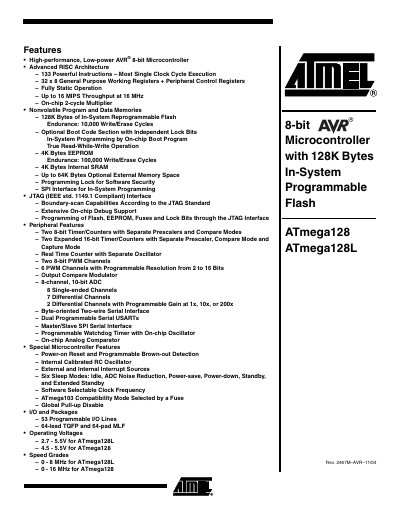
The ATmega128 and ATmega128L are high‑performance, low‑power 8‑bit AVR microcontrollers featuring up to 128 KB of in‑system programmable Flash, 4 KB EEPROM, 4 KB SRAM, 53 programmable I/O lines, and an 8‑channel 10‑bit ADC. They support a rich instruction set, multiple timer/counter modules, dual USARTs, SPI, JTAG, and various power‑saving modes.
The document includes detailed pin‑out diagrams, block diagrams of the CPU core, electrical specifications, package options (64‑lead TQFP and 64‑pad MLF), speed grades, and compatibility information with the ATmega103, allowing designers to replace the older part on existing PCBs.
| Flash Memory | 128 KB In‑System Reprogrammable Flash |
|---|---|
| EEPROM | 4 KB |
| SRAM | 4 KB |
| Programmable I/O Lines | 53 |
| ADC | 8‑channel, 10‑bit |
| Operating Voltage (ATmega128L) | 2.7 V – 5.5 V |
| Operating Voltage (ATmega128) | 4.5 V – 5.5 V |
| Package Types | 64‑lead TQFP, 64‑pad MLF |
| Speed Grade (ATmega128L) | 0 – 8 MHz |
| Speed Grade (ATmega128) | 0 – 16 MHz |
The ATmega128L operates from 2.7 V to 5.5 V.
It provides 53 programmable I/O lines.
Yes, the ATmega128 is 100 % pin compatible with the ATmega103 and can replace it on existing PCBs.
It includes an 8‑channel, 10‑bit ADC.