
AT29C040A is a 5V only in-system Flash Programmable and Erasable Read Only Memory (PEROM). Its 4 megabits of memory is organized as 524,288 words by 8 bits. Manufactured with Atmel’s advanced nonvolatile CMOS EEPROM technology, the device offers access times up to 90 ns, and a low 220 mW power dissipation. When the device is deselected, the CMOS standby current is less than 100 µA. The device endurance is such that any sector can typically be written to in excess of 10,000 times. The programming algorithm is compatible with other devices in Atmel’s 5-volt only Flash family. To allow for simple in-system reprogrammability, the AT29C040A does not require high input voltages for programming. Five-volt-only commands determine the operation of the device. Reading data out of the device is similar to reading from an EPROM. Reprogramming the AT29C040A is performed by internal address and data latches in a single cycle reprogram (erase and program).
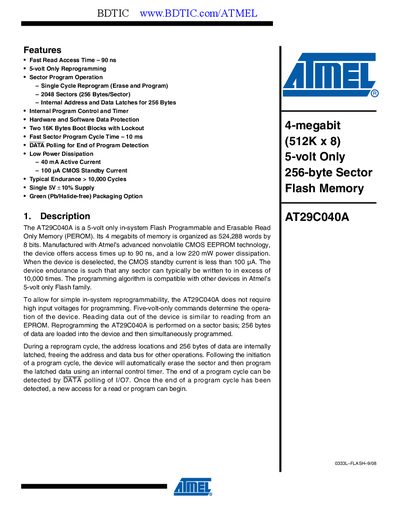
The AT29C040A is a 5‑volt‑only, in‑system flash programmable and erasable read‑only memory offering 4 Mbit (524,288 × 8) organized into 2048 sectors of 256 bytes each. It features fast 90 ns read access, low power consumption (40 mA active, 100 pA standby), and two 16 KB boot blocks with optional lockout.
The document details pin assignments for 32‑lead PLCC and TSOP packages, describes read, byte‑load, program, and erase operations, and explains both software and hardware data‑protection mechanisms. Electrical characteristics, timing parameters, and absolute maximum ratings are also provided.
| Memory size | 4 Mbit (524,288 × 8) |
|---|---|
| Supply voltage | 5 V (±10%) |
| Active current | 40 mA |
| Standby current | 100 pA CMOS |
| Read access time | 90 ns |
| Number of sectors | 2048 (256 B each) |
| Boot block size | Two 16 KB blocks |
| Operating temperature (case) | -40 °C to +85 °C |
| Package type | 32‑lead PLCC |
The device operates from a 5 V supply with a tolerance of +10 %.
It contains 2048 sectors, each 256 bytes in size.
The end of a program cycle can be detected by DATA polling for end‑of‑program detection.