
This document describes how to use the features of the ATV750 and ATV750B in the ABEL and CUPL high level description languages. The ATV750 and ATV750B are easy upgrades from a 22V10, offering twice the logic density and more flexibility in the same footprint. Both devices have 20 registers and individual clock and AR product terms for each register. Each I/O pin has a programmable polarity control and an individual output enable product term. Independent feedback paths from each register allow all of the registers to be buried without wasting the I/O pins. For the ATV750B, the registers can also be configured as D- or T-type and the clock can be selected as either a synchronous clock pin or a clock product term.
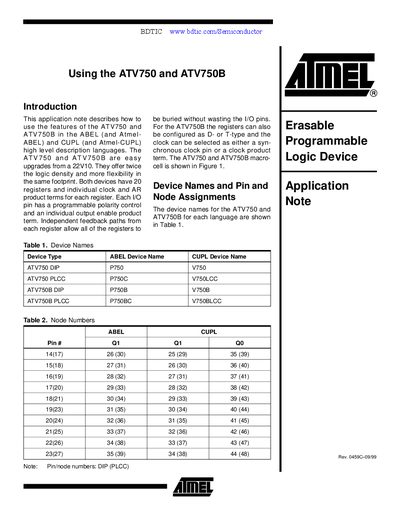
This application note explains the use of the Atmel ATV750 and ATV750B programmable logic devices in the ABEL and CUPL high‑level description languages. It covers device naming, pin and node assignments, macrocell configurations, programmable polarity control, clock options, and register types.
The document also provides a design example of a watchdog timer implemented in an ATV750B, including full ABEL and CUPL source listings and simulation vectors.
| Number of registers | 20 |
|---|---|
| Logic density compared to 22V10 | Twice the logic density |
| Register type support (ATV750) | D‑type only |
| Register type support (ATV750B) | D‑type or T‑type |
| Clock product term per register | Independent for each register |
| Programmable polarity control | Available on each I/O pin |
Both the ATV750 and ATV750B contain 20 registers.
Yes, each I/O pin includes programmable polarity control.
The ATV750B can use either the clock product term or a synchronous clock pin for each register.