
The AT27C256R is a low-power, high-performance 262,144-bit one-time programmable read-only memory (OTP EPROM) organized 32K by 8 bits. It requires only one 5V power supply in normal read mode operation. Any byte can be accessed in less than 45 ns, eliminating the need for speed reducing WAIT states on high-performance microprocessor systems. Atmel’s scaled CMOS technology provides low-active power consumption, and fast programming. Power consumption is typically only 8 mA in Active Mode and less than 10 µA in Standby. The AT27C256R is available in a choice of industry-standard JEDEC-approved one time programmable (OTP) plastic DIP, PLCC, SOIC, and TSOP packages. All devices feature two-line control (CE, OE) to give designers the flexibility to prevent bus contention. With 32K byte storage capability, the AT27C256R allows firmware to be stored reliably and to be accessed by the system without the delays of mass storage media. Atmel’s AT27C
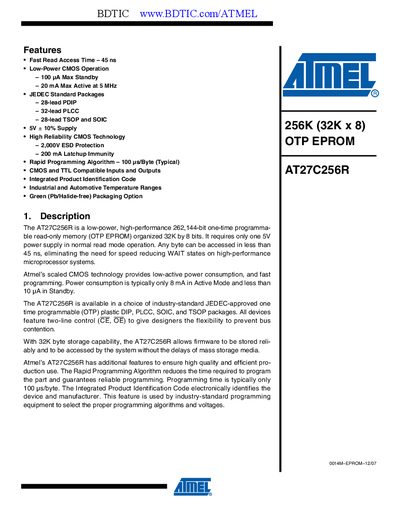
The AT27C256R is a 256‑Kbit one‑time programmable EPROM offering fast 45 ns read access, low power consumption (100 µA standby, 20 mA active at 5 MHz) and a rapid 100 ps/byte programming algorithm. It is available in standard JEDEC packages such as 28‑lead PDIP, 32‑lead PLCC, 28‑lead TSOP and SOIC.
The device operates from a 5 V ±10 % supply, supports industrial temperature ranges (‑40 °C to +125 °C) and includes 2 kV ESD protection and 200 mA latchup immunity. A 0.1 µF ceramic capacitor is recommended on Vpp to suppress transients during programming.
| Read Access Time | 45 ns |
|---|---|
| Standby Current | 100 µA max |
| Active Current (5 MHz) | 20 mA max |
| Programming Speed | 100 ps/byte (typical) |
| Supply Voltage | 5 V ±10 % |
| Package Options | 28‑lead PDIP, 32‑lead PLCC, 28‑lead TSOP, SOIC |
| Temperature Range | ‑40 °C to +125 °C (industrial) |
| ESD Protection | 2 kV |
| Latchup Immunity | 200 mA |
The device provides a read access time of 45 ns.
It operates from a 5 V supply with a ±10 % tolerance.
Standby current is limited to 100 µA maximum.
Programming typically occurs at 100 ps per byte.