
The AD8328 is a 5 V supply, DOCSIS and EuroDOCSIS compliant, programmable gain, dual input single ended output upstream cable line driver. This device supports SPI interface for programming, supports Tx-enable and Tx-disable two working modes, output impedance is 300 Ω and upper bandwidth is 107 MHz.
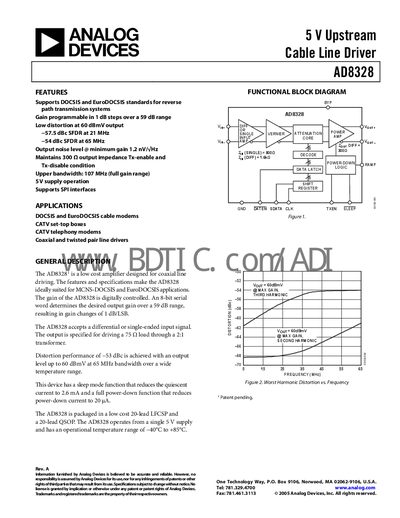
The AD8328 is a 5 V, 20‑lead LFCSP or QSOP line driver designed for coaxial cable and CATV applications. It offers digitally programmable gain in 1 dB steps over a 59 dB range, low distortion, and a 107 MHz bandwidth.
Key features include SPI‑compatible gain control, sleep mode with 20 pA quiescent current, and operation from –40 °C to +85 °C. The device drives a 75 Ω load through a 2:1 transformer and supports both differential and single‑ended inputs.
| Voltage Gain Range | 58‑60 dB |
|---|---|
| Operating Temperature Range | –40 °C to +85 °C |
| Supply Voltage Range | 4.75 V‑5.25 V |
| Quiescent Current (max gain) | 98‑140 mA |
| Sleep Mode Current | 20 pA |
The AD8328 accepts either a differential or a single‑ended input signal.
Gain is digitally controlled via an 8‑bit serial word over an SPI interface, providing 1 dB steps across a 59 dB range.
In sleep mode the device draws only 20 pA of supply current.
The AD8328 is offered in a low‑cost 20‑lead LFCSP and a 20‑lead QSOP package.