
AD8129/AD8130 are high performance, low cost, 270MHz differential receiver amplifiers. It features high conversion rate, high common-mode rejection ratio, high input impedance, low noise, low distortion and user-adjustable gain.
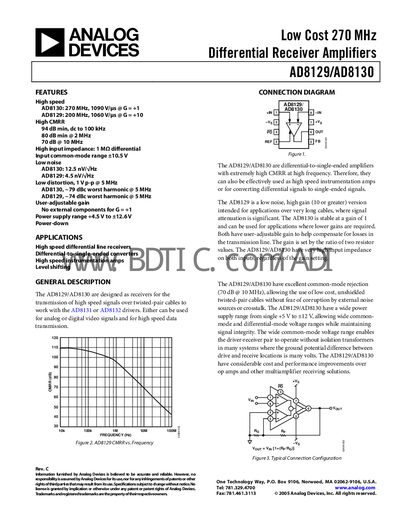
The AD8129 and AD8130 are designed as differential‑to‑single‑ended amplifiers for high‑speed video and data transmission over twisted‑pair cables. They offer high CMRR (up to 94 dB), low input‑referred noise, and a wide supply range, making them suitable for both analog and digital applications.
The document provides detailed specifications for 5 V, +5 V, and +12 V operation, including bandwidth, slew rate, noise, and power‑down behavior, as well as connection diagrams, ordering information, and layout recommendations for optimal performance.
| Input‑referred Noise (AD8130) | 12.5 nV/√Hz |
|---|---|
| CMRR (DC to 100 kHz, AD8130) | 94 dB min |
| Power Supply Range (AD8129/AD8130) | +4.5 V to +12.6 V |
| Gain Setting | User‑adjustable via resistor ratio; no external components for G = +1 |
The AD8130 has an input‑referred noise of 12.5 nV/√Hz.
Both devices operate from +4.5 V up to +12.6 V.
Gain is set by the ratio of two external resistors; no extra components are needed for a gain of +1.