
The AD8396 is a low power, high output current, dual-port ADSL/ADSL2+ line driver ideal for use as ADSL/ADSL2+ dual-channel Central Office (CO) line drivers.
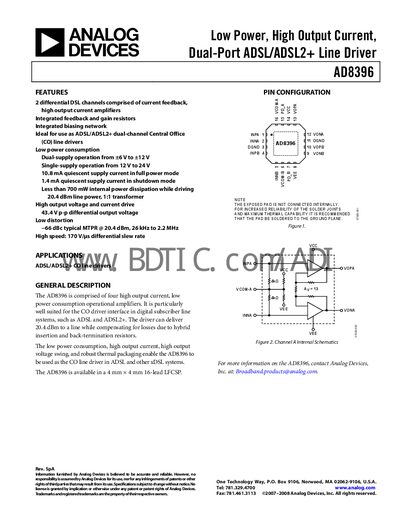
The AD8396 is a dual‑port ADSL/ADSL2+ line driver featuring low power consumption, high output current, and a wide supply voltage range. It delivers up to 20.4 dBm line power with a 43.4 V p‑p differential output and offers a high slew rate of 170 V/µs.
The device is supplied in a 4 mm × 4 mm 16‑lead LFCSP package with a pin configuration that includes VCOM‑A, PDA, VOPA, and VEE pins. For maximum reliability, the exposed pad should be soldered to the ground plane. Contact Analog Devices for more information.
| Dual‑supply voltage range | +6 V to +12 V |
|---|---|
| Single‑supply voltage range | 12 V to 24 V |
| Quiescent current (full power) | 10.8 mA |
| Quiescent current (shutdown) | 1.4 mA |
| Internal power dissipation (driving) | < 700 mW |
| Maximum line power | 20.4 dBm |
| Differential output voltage | 43.4 V p‑p |
| Typical distortion | –66 dBc MTPR @ 20.4 dBm, 26 kHz‑2.2 MHz |
| Differential slew rate | 170 V/µs |
| Package | 4 mm × 4 mm 16‑lead LFCSP |
It operates from +6 V to +12 V with dual supplies, or from 12 V to 24 V with a single supply.
The device draws 10.8 mA of quiescent current in full‑power mode.
It can deliver up to 20.4 dBm of line power.
The AD8396 is offered in a 4 mm × 4 mm 16‑lead LFCSP package.