
The ADA4937 is a low noise, ultralow distortion, high speed differential amplifier. It is an ideal choice for applications such as ADC drivers, single-ended-to-differential converters, IF and baseband gain blocks, differential buffers, and line drivers.
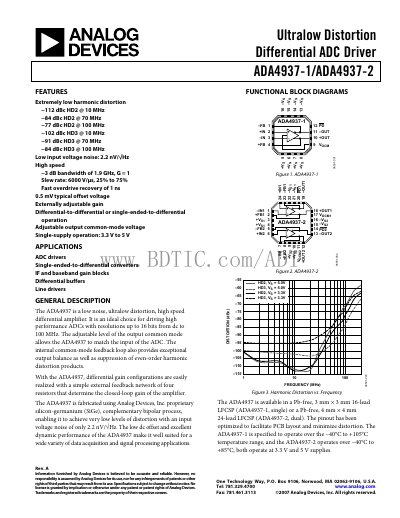
The ADA4937‑1 (single) and ADA4937‑2 (dual) are high‑speed, low‑noise differential amplifiers designed to drive high‑performance ADCs up to 16‑bit resolution. They feature adjustable gain, single‑supply operation from 3.3 V to 5 V, and an externally adjustable output common‑mode voltage.
The devices are offered in Pb‑free 16‑lead (3 mm × 3 mm) and 24‑lead (4 mm × 4 mm) LFCSP packages, operate from –40 °C to +105 °C (ADA4937‑1) or +85 °C (ADA4937‑2), and include ESD protection and power‑down pins for low‑power applications.
| Input voltage noise (RTI) at 100 kHz | 2.2 nV/√Hz |
|---|---|
| Maximum supply voltage (absolute rating) | 5.5 V |
It can operate from 3.0 V up to 5.25 V, with a maximum absolute rating of 5.5 V.
The input voltage noise is 2.2 nV/√Hz measured at 100 kHz.
Because the ADA4937 is ESD‑sensitive, proper handling and grounding must be used to avoid damage.