
DS75LV is a low-voltage (1.7V to 3.7V) digital thermometer and thermostat that provides 9-, 10-, 11-, or 12-bit digital temperature readings over a -55°C to +125°C range with ±2°C accuracy over a -25°C to +100°C range. At power-up, the DS75LV defaults to 9-bit resolution for software compatibility with the LM75. Communication with the DS75LV is achieved through a simple 2-wire serial interface. Three address pins allow up to eight DS75LV devices to operate on the same 2-wire bus, which greatly simplifies distributed temperature- sensing applications. The DS75LV thermostat has a dedicated open-drain output (O.S.) and programmable fault tolerance, which allows the user to define the number of consecutive error conditions that must occur before O.S is activated. There are two thermostatic operating modes that control thermostat operation based on user-defined trip-points (TOS and THYST). A block diagram of the DS75LV is shown in Figure 1 and detailed pin descriptions are given in Table 1.
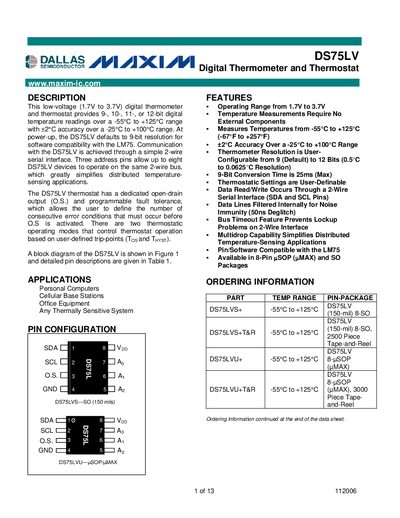
The DS75LV digital thermometer and thermostat operates from 1.7 V to 3.7 V and measures temperatures from –55 °C to +125 °C. It provides 9‑ to 12‑bit resolution via a simple 2‑wire serial interface, with up to eight devices on the same bus using three address pins.
The device includes a dedicated open‑drain thermostat output, programmable fault tolerance, and a shutdown mode for low‑power applications. Detailed electrical characteristics, pin descriptions, and configuration register settings are provided for system integration.
| Supply Voltage | 1.7 V to 3.7 V |
|---|---|
| Operating Temperature Range | -55 °C to +125 °C |
| Resolution | 9‑ to 12‑bit (0.5 °C to 0.0625 °C) |
| 9‑bit Conversion Time | 25 ms (max) |
| Address Pins | Three address pins (up to 8 devices) |
| Thermostat Output | Dedicated open‑drain (O.S.) |
| Bus Timeout Feature | Prevents lock‑up on 2‑wire interface |
The DS75LV operates from 1.7 V to 3.7 V.
It has three address pins, allowing up to eight devices on the same 2‑wire bus.
The default resolution is 9‑bit, giving a conversion time of 25 ms.
Yes, setting the SD bit puts the device into a low‑power standby state while keeping the 2‑wire interface active.