
MX7575/MX7576 are high-speed (5µs/10µs), microprocessor (µP) compatible, 8-bit analog-to-digital converters (ADCs). MX7575 provides an on-chip track/hold function that allows accurate acquisition and digitization of full-scale signals up to 50kHz (386mV/µs slew rate). Both ADCs use a successive-approximation technique to achieve fast conversions and low power dissipation. MX7575/MX7576 operate with a +5V supply and a 1.23V external reference. They accept input voltages ranging from 0V to 2VREF. MX7575/MX7576 are easily interfaced to all popular 8-bit µPs through standard CS and RD control signals. These signals control conversion start and data access. A BUSY signal indicates the beginning and end of a conversion. Since all the data outputs are latched and three-state buffered, MX7575/MX7576 can be directly connected to a µP data bus or system I/O port. Maxim also makes MAX165, a plug-in replacement for MX7575 with an internal 1.23V reference. For applications that require a differential analog input and an internal reference, MAX166 is recommended.
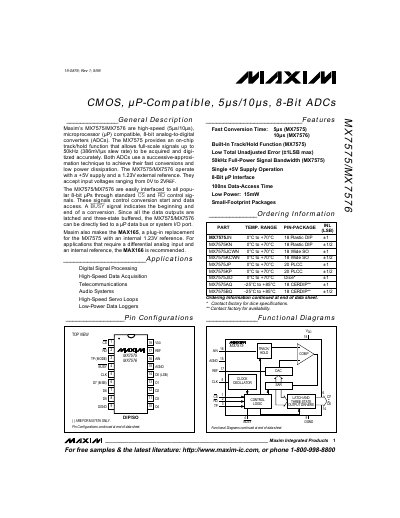
The Maxim MX7575/MX7576 are CMOS, microprocessor-compatible 8-bit analog-to-digital converters that use successive approximation. The MX7575 provides a 5µs conversion time and on-chip track/hold; the MX7576 provides a 10µs conversion time.
Both devices use a +5V supply and a 1.23V external reference, accept inputs from 0V to 2VREF, and provide latched, three-state outputs. The document includes pin descriptions, ordering information, electrical characteristics, and timing characteristics.
| Resolution | 8 bits; no missing codes |
|---|---|
| Conversion time | 5µs (MX7575); 10µs (MX7576) |
| Track/hold | On-chip (MX7575) |
| Full-power signal bandwidth | 50kHz (MX7575) |
| Total unadjusted error | ±1LSB maximum |
| Supply voltage | +5V |
| Reference voltage | 1.23V nominal |
| Analog input range | 0V to 2VREF |
| Data-access time | 100ns |
| Power dissipation | 15mW |
The MX7575 converts in 5µs; the MX7576 converts in 10µs.
Yes. The MX7575 includes an on-chip track/hold function.
They operate with a +5V supply and a 1.23V external reference.
It indicates the beginning and end of a conversion.