
The MAX630 and MAX4193 are CMOS DC-DC regulators designed for simple, efficient, minimum-size DC-DC converter circuits in the 5mW to 5W range. The MAX630 and MAX4193 provide all control and power handling functions in a compact 8-pin package: a 1.31V bandgap reference, an oscillator, a voltage comparator, and a 375mA N-channel output MOSFET. A comparator is also provided for low-battery detection. Operating current is only 70µA and is nearly independent of output switch current or duty cycle. A logic-level input shuts down the regulator to less than 1µA quiescent current. Low-current operation ensures high efficiency even in low-power battery-operated systems. The MAX630 and MAX4193 are compatible with most battery voltages, operating from 2.0V to 16.5V. The devices are pin compatible with the Raytheon bipolar circuits, RC4191/2/3, while providing significantly improved efficiency and low-voltage operation. Maxim also manufactures the MAX631, MAX632, and MAX633 DC-DC converters, which reduce the external component count in fixed-output 5V, 12V, and 15V circuits. See Table 2 at the end of this data sheet for a summary of other Maxim DC-DC converters.
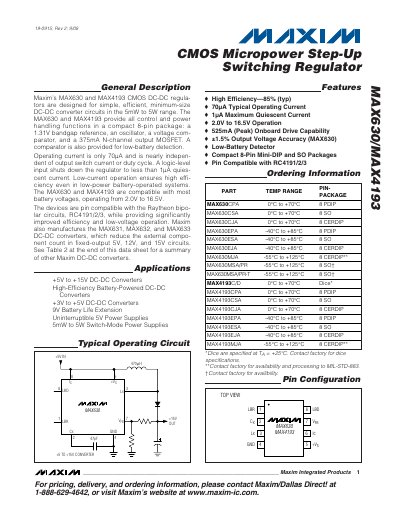
The Maxim MAX630 and MAX4193 are CMOS DC‑DC step‑up switching regulators designed for low‑power battery‑operated systems. They operate from 2.0 V to 16.5 V, provide up to 525 mA peak output current, and feature a typical efficiency of 85 %.
The document details absolute maximum ratings, electrical characteristics, pin descriptions, external component recommendations, and design guidelines such as inductor selection, filter capacitor sizing, and low‑battery detection circuitry.
| Supply Voltage | 2.0 V to 16.5 V |
|---|---|
| Typical Operating Current | 70 µA |
| Shutdown Quiescent Current | < 1 µA |
| Peak Output Current | 525 mA |
| Efficiency (typical) | 85 % |
| Output Voltage Accuracy (MAX630) | ±1.5 % |
| Operating Temperature Range (MAX630C, MAX4193C) | 0 °C to +70 °C |
The typical operating current is 70 µA.
The device can deliver a peak output current of 525 mA.