
The XC6420 series is a small dual CMOS LDO regulator with 2-channel 150mA outputs. The series features high speed, high accuracy, high ripple rejection and low dropout voltage. The series is capable of high density board installation by the small package of two low on-resistance regulators. Each output voltage is internally set in a range from 1.2V to 3.6V in increments of 0.05V with ±2% accuracy. The EN function controls the two regulators on/off independently. In the stand-by mode, the electric charge at the output capacitor CL is discharged via the internal switch and as a result the VOUT pin quickly returns to the VSS level. The series is also compatible with low ESR ceramic capacitors. The high level of output stability is maintained even during frequent load fluctuations, due to the excellent transient response performance. The two regulators are completely isolated so that a cross talk during load fluctuations is minimized.
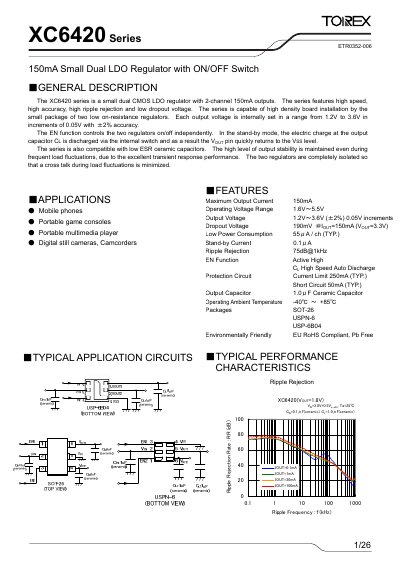
The XC6420 Series is a small dual CMOS LDO regulator offering two independent 150 mA output channels. Each output voltage can be set from 1.2 V to 3.6 V in 0.05 V steps with ±2 % accuracy. The EN pins provide independent on/off control for each regulator, and a standby current as low as 0.1 µA.
The device is designed for high‑speed, high‑accuracy operation with 75 dB ripple rejection at 1 kHz and a typical dropout voltage of 190 mV at 150 mA. It requires at least a 1.0 µF ceramic capacitor on both the input and output pins, placed as close as possible to the IC for optimal stability.
| Maximum Output Current | 150 mA |
|---|---|
| Output Voltage Range | 1.2 V – 3.6 V (±2 %) |
| Dropout Voltage | 190 mV @ IOUT=150 mA (VOUT=3.3 V) |
| Ripple Rejection | 75 dB @ 1 kHz |
| Stand‑by Current | 0.1 µA |
The EN pin provides an active‑high signal that independently turns each regulator on or off, and in shutdown mode it discharges the output capacitor so VOUT returns to VSS.
A ceramic capacitor of at least 1.0 µF should be connected as close as possible to the VOUT and VSS pins for phase compensation.
Each channel can supply up to 150 mA of output current.