
The XC6503 series is a 500mA high speed CMOS LDO regulator that can provide stable output voltages even without a load capacitor CL. The devices are available in fixed output voltage from 1.2V to 5.0V in 0.05V increments. The CL capacitor-less is possible because phase compensation is carried out internally unlike other LDOs where it is done externally. It results in saving board design space. The current limit fold-back circuit and thermal shutdown circuit work as protection circuit. The XC6503P is a 3-Terminal regulator and the XC6503D has a chip enable function, which enables the entire circuit to be turned off by a low level input signal to the CE pin. When a CL capacitor is used, the IC can discharge the electric charge stored at the output capacitor through the internal switch while in standby state, and as a result the VOUT quickly returns to the VSS level.
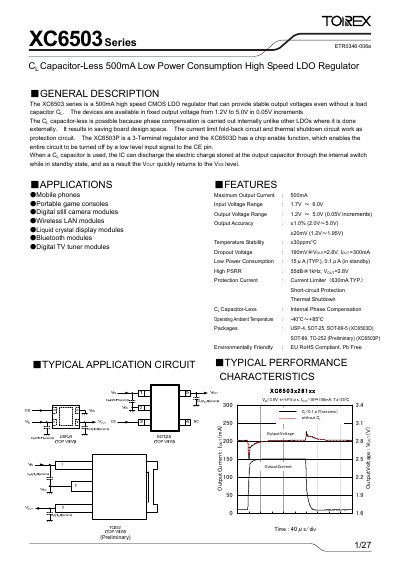
The XC6503 Series is a 500 mA high‑speed CMOS LDO regulator that can provide stable output voltages without an external load capacitor (C L). It offers fixed output options from 1.2 V to 5.0 V in 0.05 V steps and includes internal phase compensation, current‑limit fold‑back, and thermal‑shutdown protection.
Key features include a low quiescent current (15 µA typ), high PSRR (55 dB at 1 kHz), and optional chip‑enable control (CE pin) in the XC6503D variant. Typical applications are mobile phones, portable game consoles, camera modules, wireless LAN, LCD modules, Bluetooth, and digital TV tuners.
| Maximum Output Current | 500 mA |
|---|---|
| Input Voltage Range | 1.7 V – 6.0 V |
| Output Voltage Range | 1.2 V – 5.0 V (0.05 V increments) |
| Dropout Voltage | 190 mV @ VOUT=2.8 V, IOUT=300 mA |
| Quiescent Current (Low Power) | 15 µA typ |
| Power Supply Rejection Ratio (PSRR) | 55 dB @ 1 kHz |
| Current Limiter (typical) | 630 mA |
The device can deliver up to 500 mA of output current.
No, the regulator is designed to operate without a load capacitor (C L).
The XC6503D includes a CE pin; pulling this pin low disables the entire circuit.
It includes a current‑limit fold‑back circuit, short‑circuit protection, and a thermal‑shutdown circuit.