
This document is about Keyence KV1000 human machine and each brand connection instructions. It mainly introduces communication speed, controller station number, control area/status area, controller connection instructions and other content.
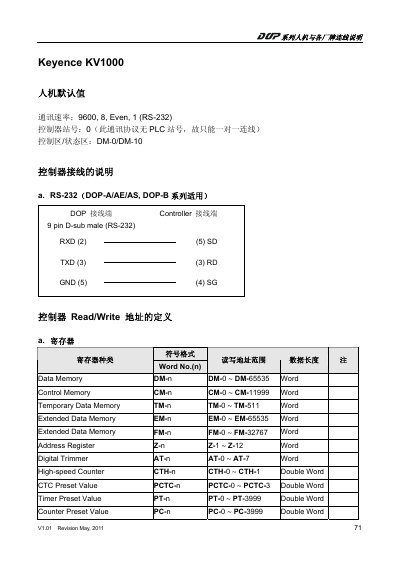
The document explains how to connect the Keyence KV1000 human‑machine interface to various controllers using an RS‑232 serial link. It lists the default communication settings, controller station number, and the register address format used for read/write operations.
Included are the pinout for the 9‑pin D‑sub connector, definitions of data, control, temporary, and extended memory areas, as well as the format for relay and counter contacts. The revision information (V1.01, May 2011) is also noted. This manual is written in Chinese.
| Communication speed | 9600, 8, Even, 1 (RS‑232) |
|---|---|
| Controller station number | 0 (one‑to‑one connection only) |
| Connector type | 9‑pin D‑sub male (RS‑232) |
| Document revision | V1.01, May 2011 |
The default communication speed is 9600 baud, 8 data bits, even parity, 1 stop bit (RS‑232).
The controller station number is set to 0, and the protocol supports only a one‑to‑one connection.
The DOP connector uses a 9‑pin D‑sub male connector for RS‑232 communication.