
RN1610,RN1611 is a NPN type dual integrated silicon crystal transistor launched by Toshiba. It is mainly used for switching, inverter circuits, interface circuits, etc. The characteristics of this tube are that it has a super-miniature 6-pin package, integrates two tubes, and integrates two base bias resistors, which can reduce the number of components, simplify the assembly process, and is suitable for a variety of circuit designs.
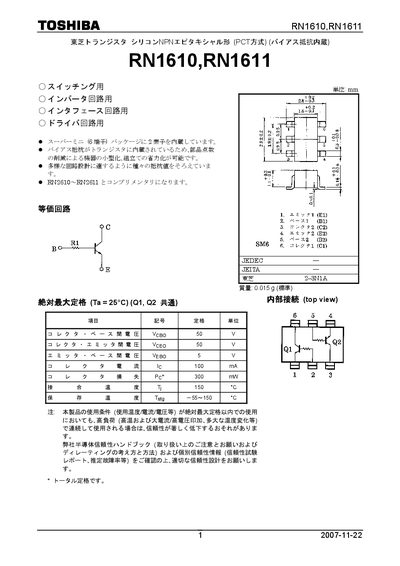
The RN1610 and RN1611 transistors integrate a bias resistor within the device, allowing reduction of external components, smaller circuit size, and easier assembly. They are intended for switching applications in various interface, driver, and inverter circuits.
The datasheet provides absolute maximum ratings, electrical characteristics such as collector‑base voltage of 50 V, collector‑emitter voltage of 50 V, and a transition frequency up to 250 MHz, as well as recommended operating temperature limits from –55 °C to 150 °C. Users are advised to consult Toshiba’s reliability handbooks and application notes for proper design and safety considerations. This manual is written in Japanese.
| Collector‑Base Voltage (Vcbo) | 50 V |
|---|---|
| Collector‑Emitter Voltage (Vceo) | 50 V |
| Emitter‑Base Voltage (Vebo) | 5 V |
| Maximum Collector Current (Ic) | 100 mA |
| Power Dissipation (Pc) | 300 mW |
| Operating Temperature Range | -55 °C to 150 °C |
| Input Resistance (Ri) | RN1610: 3.29 – 6.11 kΩ, RN1611: 7 – 13 kΩ |
The maximum collector‑base voltage is 50 V.
They are rated for operation from –55 °C up to 150 °C, but continuous high‑load use may reduce reliability.