
TC74LVX373F/FT is an Octal D-Type Latch with 3-State Output produced by Toshiba. It features low power consumption and high speed, supporting 3V systems.
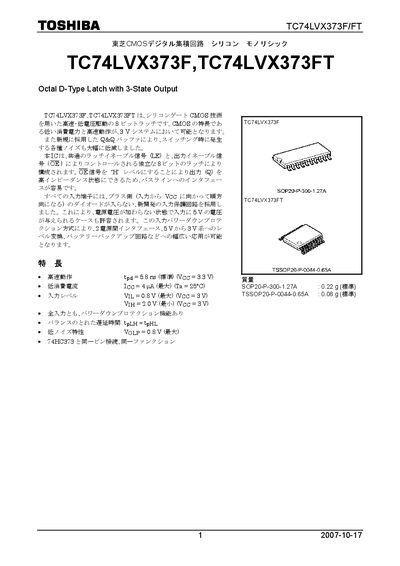
The TC74LVX373F/FT is an octal D‑type latch with three‑state outputs, built with Toshiba's silicon‑gate CMOS technology for high‑speed, low‑voltage operation. It features input power‑down protection, balanced delay times and low noise characteristics, making it suitable for a wide range of interfacing applications.
The document presents the device’s pin configuration, truth table, electrical and timing specifications, package dimensions and handling guidelines. It also lists absolute maximum ratings, recommended operating conditions and noise performance, enabling designers to integrate the latch safely and reliably into their circuits. This manual is written in Japanese.
| Propagation delay (tpd) | 5.8 ns (typical) |
|---|---|
| Quiescent current (I_CC) | 4 nA (max) |
| Input low voltage (V_IL) | 0.8 V (max) |
| Input high voltage (V_IH) | 2.0 V (min) |
| Supply voltage (VCC) range | 2.0 V to 3.6 V |
| Operating temperature range | -40 °C to 85 °C |
The device operates with a supply voltage between 2.0 V and 3.6 V.
The typical propagation delay is 5.8 ns.
The device is rated for operation from –40 °C to +85 °C.