
Operation manual for the Moog Mini Moog Model D synthesizer covering setup, output, oscillators, controllers, modulation, and signal types.
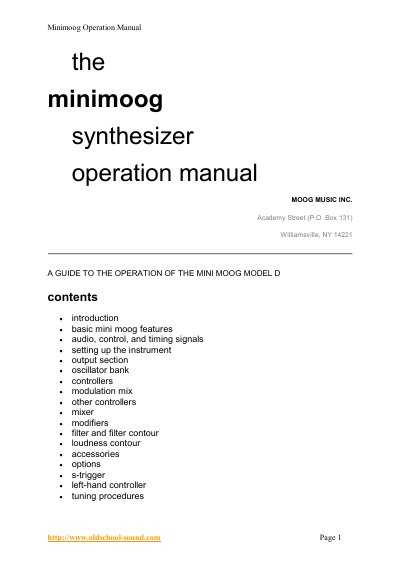
This operation manual for the Moog Mini Moog Model D synthesizer explains the instrument's audio, control, and timing signals and then describes setting up the instrument, the output section, and the oscillator bank. It gives step-by-step instructions for switches, knobs, tuning, and the 44-note keyboard.
The table of contents also lists the modulation mix, mixer, modifiers, filter and filter contour, loudness contour, accessories, options, S-trigger, left-hand controller, and tuning procedures.
| Sound sources | Five sound sources: three oscillators, one noise source, and one microphone preamplifier |
|---|---|
| Keyboard | 44-note keyboard for the right hand |
| Oscillator range switch positions | 6 positions |
| Waveform selections | Six waveforms |
| Power requirement | 117 Volt A.C. outlet |
| Sound modifiers | Lowpass filter and amplifier with their own contour generators |
The manual specifies a conventional 117 Volt A.C. outlet.
The manual says to give it about ten minutes to warm up before tuning and playing.
It provides a signal for tuning the instrument and is not used during actual performance.
It has three oscillators for pitched tones, plus a noise source and a microphone preamplifier.